
🔬 AlOx vs Metallised PET — When to Use Which (And Why EPR April 2026 Forces You to Decide)
📖 16-min read | Plant + Brand Owner Strategic Decision | Published May 2026 | Bookmark for the EPR conversation
On April 1, 2026, India's Plastic Waste Management (Amendment) Rules went live. Multi-layered plastic packaging — the kind every metallised structure sits in — is now Category III, the most expensive EPR (Extended Producer Responsibility) category. Brand owners are calling converters and asking the same question: "Can we move off MLP without losing barrier performance?" The honest technical answer is yes, often, by switching from metallised PET to AlOx PET. But that switch is not free — it cuts your metalliser's capacity by 62% on the same line and triples your conversion cost per kg. This blog gives plant managers, converters, and procurement teams the full decision framework: when AlOx pays off, when metallised PET still wins, and how to model the EPR-vs-capacity-vs-cost trade-off honestly.
All numbers from the same plant, same machine, same crew — locked across Blog #28, #29, and #30.
📜 The April 2026 Pivot — Why This Decision Is on Every Brand Owner's Desk
For more than a decade, the standard high-barrier flexible-packaging structure for snacks, coffee, dry foods, and pharma in India has been a 3-to-5-layer laminate built around metallised PET — typically PET 12μm + Met-PET 12μm + PE 50μm, sometimes with foil or printing layers added. This structure delivers excellent barrier (OTR <1, WVTR <1) at low cost, has been refined over decades, and runs on every metalliser line in the country.
It also happens to be impossible to recycle through any mainstream Indian plastic waste channel.
That gap between "engineering-perfect" and "recyclable" never mattered much, until the Ministry of Environment, Forest and Climate Change notified the Plastic Waste Management (Amendment) Rules, 2026 via G.S.R. 237(E) on 31 March 2026. The amendment took effect 1 April 2026 and changed the rules of the game in three ways:
- Mandatory recycled content in plastic packaging, by category, with phased increases through FY 2027-28
- Category-specific Environmental Compensation (EC) rates for shortfalls — and Category III MLP got the steepest rates
- Independent verification by Registered Environment Auditors, replacing self-declaration with audited claims
For a brand owner shipping FMCG sachets in PET/Met-PET/PE, that single notification reclassified their packaging into the most expensive EPR category. The natural question — "what do we switch to?" — has only one technically defensible answer for high-barrier transparent applications: AlOx-coated PET in a mono-PET structure.
🔬 The Two Films — What They Actually Are
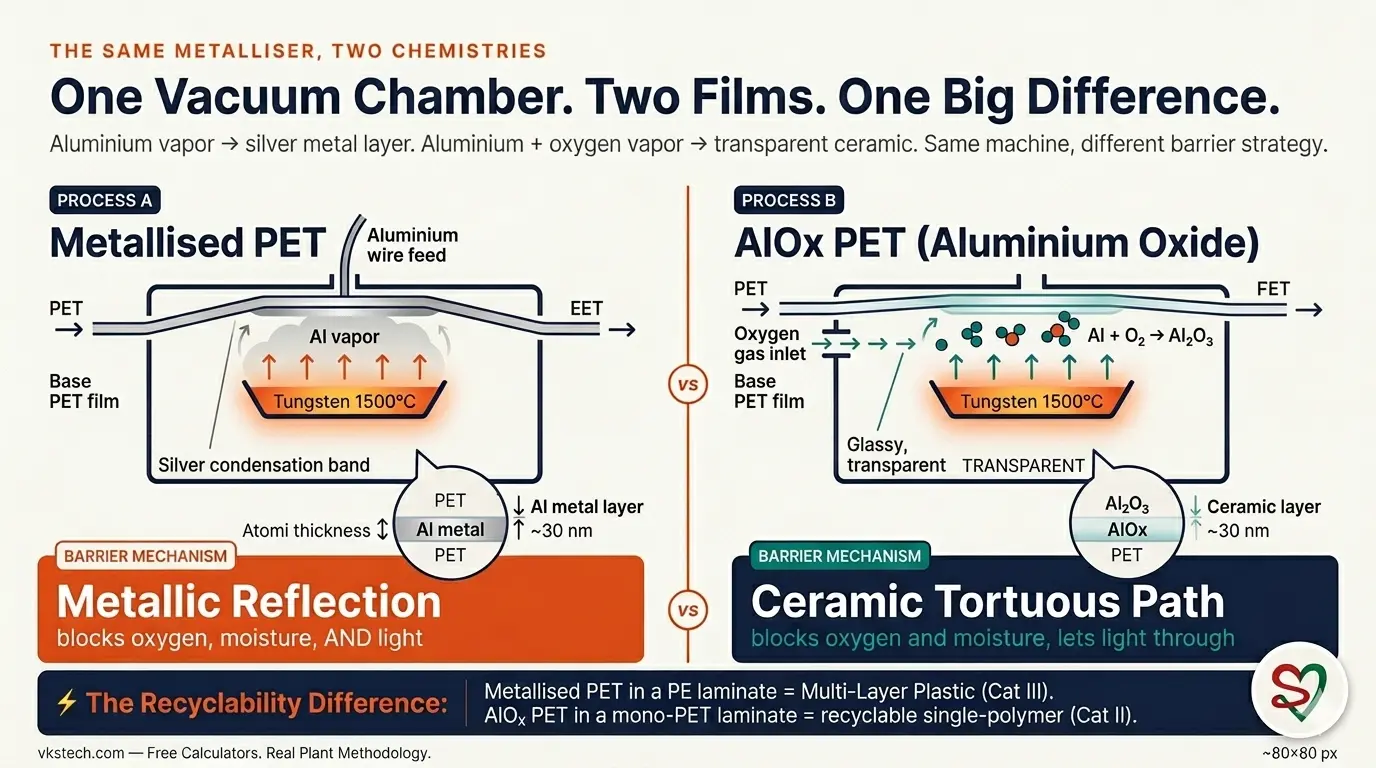
Both metallised PET and AlOx PET are made on the same vacuum metalliser, but the chemistry inside the chamber is different.
Metallised PET is the classic process. PET base film passes through a vacuum chamber. Aluminium wire is fed onto a heated tungsten boat at ~1500°C. The aluminium evaporates as pure metal vapor and condenses on the moving film as a continuous metallic layer, typically 30-50 nm thick (controlled by Optical Density, OD M2.2 or M2.5). The result is the familiar opaque silver film — high reflectance, very low oxygen and moisture transmission, near-zero light penetration. Industry workhorse since the 1970s.
AlOx PET uses the same machine but introduces a controlled flow of oxygen into the chamber during evaporation. The aluminium vapor reacts with the oxygen mid-flight and deposits as aluminium oxide (Al₂O₃) — a transparent ceramic, not a metal. The deposited layer is also 30-50 nm thick but has a completely different character: glass-clear, slightly hazier (max 2.5%), with optical transmittance around 90%. Barrier performance is comparable to metallised PET (OTR ~1, WVTR ~1) — both films deliver foil-class numbers from a layer that's a few atoms thick.
The recyclability gap appears in how each film gets used in a finished package. Metallised PET is almost always laminated to a sealant layer (PE or CPP) that is a different polymer family — creating an MLP. AlOx PET, because of its transparency and chemistry, can be laminated to PET sealants (mono-PET structures) or used as the barrier layer in mono-PE packaging (with AlOx-coated PE), preserving the single-polymer recycling pathway.
📊 Barrier Performance — Side by Side
The tactical question every converter faces: does AlOx actually deliver the barrier we built around metallised PET? The honest answer is yes for almost everything except high-light-sensitive products.
| Property | Metallised PET 12μm | AlOx PET 12μm | Winner |
|---|---|---|---|
| OTR (cc/m²/day) | <1 | ~1 | Tie |
| WVTR (g/m²/day) | <1 | ~1 | Tie |
| Light barrier | ~0% transmission (opaque) | ~90% transmission | Met PET |
| UV barrier | Excellent | Poor (needs UV inhibitor) | Met PET |
| Transparency | None (silver mirror) | Glass-clear, haze ≤2.5% | AlOx |
| Metal detection | Triggers metal detectors | Passes — no metal | AlOx |
| Microwave-able | No (sparks) | Yes | AlOx |
| Flex-crack resistance | Moderate (metal cracks) | Better (ceramic flexes) | AlOx |
| Recyclability in mono-PET | No (multi-layer) | Yes (<5% non-PET content) | AlOx |
The decision rule that emerges: if your product needs light protection (sensitive oils, vitamins, photo-sensitive pharma), metallised PET stays. If your product needs oxygen/moisture barrier with see-through capability (snacks where consumers want to see contents, microwaveable retort, premium dry foods, mono-material recyclable packaging), AlOx wins.
⚙️ Operational Reality — Same Machine, Different Numbers
This is where most converters get blindsided. The lab tests confirm AlOx works. The brand owner approves the trial. Production starts — and the metalliser's monthly output collapses. The reason is not equipment failure; it is the cumulative effect of every cycle parameter changing simultaneously.
Below is the side-by-side from the same plant, same line, same crew running both products in different campaigns. The standard PET baseline matches Blog #30; the AlOx column is real plant data.
| Parameter | Met PET 12μm M2.2 | AlOx PET 12μm | Δ |
|---|---|---|---|
| Setup per roll | 20 min | 30 min | +50% |
| Vacuum + Heating | 20 min | 25 min | +25% |
| Average line speed | 800 m/min | 600 m/min | −25% |
| Average jumbo length | 54,000m | 36,000m | −33% |
| Average jumbo width | 3,000mm | 2,360mm | −21% |
| Vent | 10 min | 10 min | = |
| Boat-change time | 10 min | 60 min | +500% |
| Boat-set life | 6 lakh m | 1.5 lakh m | −75% |
| Source cleaning/day | 20 min | 240 min | +1100% |
| Cycle time per roll | 118.4 min | 139.4 min | +18% |
| Available time per day | 1,420 min | 1,200 min | −15% |
| Rolls per day | 12 | 8.61 | −28% |
| Roll weight | 2,683 kg | 1,407 kg | −48% |
| Daily capacity | 32.17 MT/day | 12.11 MT/day | −62% |
Same machine, same crew. AlOx capacity is 37% of metallised PET capacity. Three operational changes destroy throughput simultaneously: (a) boat changes balloon from 10 min to 60 min — oxide chemistry burns boats six times faster, requiring full clean-out instead of swap; (b) source cleaning explodes from 20 min/day to 240 min/day (4 hours, every day) because oxide deposits coat the chamber walls and need aggressive scraping; (c) jumbo width drops from 3000mm to 2360mm because edge uniformity is harder to maintain on a transparent ceramic. None of these limits show up on the metalliser vendor's datasheet. They only appear after 60 days of running AlOx campaigns at scale.
💰 The EPR Math — When AlOx Pays Off
The capacity hit and the conversion-cost hit are real. AlOx triples the per-kg conversion cost on the metalliser (from ~₹15.59/kg actual on standard PET to ~₹46.77/kg actual on AlOx — 3× the equivalence factor we derived in Blog #29). For a converter looking at metalliser P&L in isolation, AlOx looks terrible.
But the EPR liability landscape changes the math. The April 2026 amendment classifies plastic packaging into four categories. The two that matter for this comparison:
| EPR Category | What it covers | Recycled content target | Indicative EC rate (shortfall) |
|---|---|---|---|
| Category II Flexible mono-material | Mono-PET, mono-PE, mono-PP flexible packaging | 10% (FY26-27) → 20% (FY27-28) | ~₹3-5/kg |
| Category III Multi-Layered Plastic (MLP) | PET/AL/PE laminates, metallised PET in multi-polymer structures | 5% (FY26-27) → 10% (FY27-28) | ~₹15-20/kg |
EC rates are indicative ranges from CPCB EPR marketplace activity in early 2026; actual rates fluctuate. Verify current rates via the CPCB portal before any compliance modeling.
For a brand owner shipping 500 MT/year of MLP-based snack packaging, the math at 100% EPR shortfall (worst case, no recycled content procured):
Scenario A — Stay with metallised PET / MLP (Category III):
- EPR shortfall liability: 500 MT × 1000 kg × ₹17.50/kg (mid-range) = ₹87.5 lakh/year
- Conversion cost (metallised PET): 500 × 1000 × ₹15.59 = ₹77.95 lakh/year
- Total: ₹1.65 crore/year
Scenario B — Switch to AlOx mono-PET (Category II):
- EPR shortfall liability: 500 × 1000 × ₹4/kg (mid-range) = ₹20 lakh/year
- Conversion cost (AlOx): 500 × 1000 × ₹46.77 = ₹2.34 crore/year
- Total: ₹2.54 crore/year
Pure EPR delta: −₹67.5 lakh/year · Conversion cost delta: +₹1.56 crore/year · Net: +₹89 lakh/year more expensive on AlOx
At first glance, AlOx loses badly. But this naive model misses three realities that flip the answer for high-volume brands:
- Recycled content is procurable, not just penalty-payable. A brand can buy EPR certificates from compliant recyclers — Category II certificates trade at ₹3-5/kg, Category III at ₹15-20/kg. A converter who switches half their volume to mono-PET reduces their certificate purchase cost by 70% on the switched portion.
- The conversion-cost delta is largely a metalliser-line problem. If the brand owner negotiates with multiple metalliser plants, the cost premium of AlOx normalizes to ~1.8-2× over time as more lines become AlOx-capable. The 3× number is today's reality, not 2027's.
- Brand-value premium for "recyclable" labelling. Modern e-commerce and modern-trade buyers pay 5-8% retail premium for visibly recyclable packaging — a number that, on FMCG margins, often dwarfs the EPR + conversion cost delta combined.
The honest framing: AlOx is not a cost-saving move on the metalliser. It is a strategic move that trades higher line cost for lower regulatory risk and a higher brand premium. Whether the math works depends on volume, product positioning, and how seriously the brand takes 2027 EPR target tightening (Cat II 10% → 20%, Cat III 5% → 10%).
✅ When Metallised PET Still Wins
AlOx is the future of mono-material flexible packaging, but metallised PET is not going away — and for some applications, it shouldn't. Stay with metallised PET when:
- Light barrier is non-negotiable. Vitamins, fish oil, edible oils, light-sensitive pharmaceuticals, photo film. AlOx fails the UV-blocking test by definition.
- Metalised aesthetics are part of the brand identity. Premium tobacco, ghee tins, gift packs — the silver mirror finish is the design choice.
- Cost-driven low-margin SKUs. Mass-market sachets at ₹5 retail can't absorb a 3× conversion cost premium even with EPR savings.
- Brand owner has a working PCR strategy for MLP. If the brand has secured supply of recycled MLP feedstock at viable prices, the EPR pressure on Category III is offset and metallised PET stays viable.
- Target shelf life > 12 months in extreme conditions. AlOx flex-crack performance is good but multi-year retort applications still favour foil-or-metal barriers.
🌟 When AlOx Wins
Switch to AlOx (in a mono-PET or mono-PE structure) when:
- Product visibility is a buying decision. Premium snacks, dry fruits, organic foods, microwaveable meals — consumer wants to see the product before purchase.
- Brand has made a public mono-material commitment. Once a brand has pledged "100% recyclable by 2027" in its sustainability report, AlOx becomes the only path to high-barrier mono-material.
- Microwaveable / metal-detector applications. Ready-meals and pharma both increasingly demand non-metallic barrier.
- Volume is high enough to absorb the conversion premium. Brands shipping >1000 MT/year see EPR savings + brand premium starting to net positive against the conversion cost premium.
- The customer is in EU or US export markets. EU PPWR (Packaging and Packaging Waste Regulation) and US state-level EPR (California, Oregon) already mandate mono-material on tighter timelines than India. AlOx is a single design that satisfies all three regulatory regimes.
🎯 Live Decision Helper — Which Film for Your Application?

Five inputs — light barrier requirement, recyclability priority, annual volume, conversion cost ceiling, target market. Output: recommended structure with reasoning.
🚀 Where to Start at Your Plant
Whether you are a converter exploring AlOx capability or a brand owner running a switch evaluation, here is the practical 4-week sequence:
- Week 1 — Demand-side audit. Pull the SKU list. For each SKU, classify under EPR Category II, III, or IV. Sum annual volume per category. Apply current EC rates. This is your baseline EPR liability if you change nothing.
- Week 2 — Technical fit assessment. For each MLP SKU, check the 4-lens framework above (light barrier, transparency, microwave, shelf life). Classify as "AlOx-feasible" or "Met-PET-permanent". Most snack and dry food SKUs will be AlOx-feasible; most pharmaceutical and oil/vitamin SKUs will be Met-PET-permanent.
- Week 3 — Plant capacity model. Use the Met M/C Capacity calculator to model what happens to your monthly output if AlOx volume rises from 0% to 30% to 50% of mix. The capacity drop is the operational constraint that determines how fast you can switch.
- Week 4 — Financial scenario. Use the Decision Helper above on each AlOx-feasible SKU at production volumes. Build the year 1 / year 3 net cost picture. Most brands find a "switch 30% of MLP to AlOx by 2027" pathway is financially defensible — the 100% switch rarely is, the 0% switch fails the EPR-trajectory test.
This blog ties the entire series together — financial framework + capacity engine + the strategic decision driving 2026.
- Blog #22: Boat-Set SMED — 2017 case study
- Blog #23: Inter-Cycle SMED — 2016 case study
- Blog #24: Metallised Waste 1.8% → 0.9%
- Blog #25: 2 SMED Levers Hub
- Blog #26: Bare Film Waste 2% → 1%
- Blog #27: Film Roll Weight Formula
- Blog #28: Conversion Cost — Actual vs Equivalent
- Blog #29: Calculate Equivalent Factor for Any Material
- Blog #30: How to Calculate Capacity of a Metalliser
- This blog (#31): AlOx vs Metallised PET — The EPR Decision (you are here)
Trying to model the EPR cost for your specific product mix? Wondering whether your line can run AlOx at all? Negotiating with a converter on AlOx vs Met PET pricing? Drop your question in the Q&A section at the bottom of this page — Vivek answers personally.
📌 What's next. The next blog in this series goes deeper on the operational side: Blog #32 — The 5 Met Downtimes — exactly where your 1,420 daily minutes go on standard PET, and the 240-min source-cleaning reality on AlOx campaigns. After that, OEE for Metallisers (Blog #33) closes the productivity loop by combining capacity, downtime, and waste into a single number plant managers can defend in any review meeting.
🔬 AlOx vs Metallised PET — कब कौन सा इस्तेमाल करें (और क्यों EPR April 2026 आपको decide करने पर मजबूर करता है)
📖 16-min read | Plant + Brand Owner Strategic Decision | May 2026 में published | EPR conversation के लिए bookmark करें
1 April 2026 को India का Plastic Waste Management (Amendment) Rules लागू हो गया। Multi-layered plastic packaging — जिस तरह की हर metallised structure होती है — अब Category III है, सबसे महंगी EPR (Extended Producer Responsibility) category। Brand owners converters को call कर रहे हैं और एक ही सवाल पूछ रहे हैं: "क्या हम MLP से बिना barrier performance गँवाए हट सकते हैं?" Honest technical answer है हाँ, अक्सर, metallised PET से AlOx PET पर switch करके। पर वो switch free नहीं है — वो आपकी metalliser की capacity same line पर 62% काट देता है और conversion cost per kg को triple कर देता है। ये blog plant managers, converters, और procurement teams को पूरा decision framework देता है: कब AlOx pay off करता है, कब metallised PET अब भी जीतता है, और EPR-vs-capacity-vs-cost trade-off को honestly कैसे model करें।
सारे numbers same plant, same machine, same crew से — Blog #28, #29, और #30 पर locked।
📜 April 2026 का Pivot — क्यों ये decision हर brand owner के desk पर है
एक दशक से ज़्यादा, snacks, coffee, dry foods, और pharma के लिए India में standard high-barrier flexible-packaging structure metallised PET के around 3-to-5-layer laminate रही है — typically PET 12μm + Met-PET 12μm + PE 50μm, sometimes foil या printing layers के साथ। ये structure low cost पर excellent barrier (OTR <1, WVTR <1) देती है, decades में refine हुई है, और देश की हर metalliser line पर चलती है।
और ये किसी भी mainstream Indian plastic waste channel से recycle करना impossible भी है।
"engineering-perfect" और "recyclable" के बीच का वो gap कभी ज़्यादा matter नहीं किया, जब तक Ministry of Environment, Forest and Climate Change ने 31 March 2026 को G.S.R. 237(E) के through Plastic Waste Management (Amendment) Rules, 2026 notify नहीं किया। Amendment 1 April 2026 से प्रभावी हुआ और तीन तरह से game के rules बदल दिए:
- Mandatory recycled content plastic packaging में, by category, FY 2027-28 तक phased increases के साथ
- Category-specific Environmental Compensation (EC) rates shortfalls के लिए — और Category III MLP को सबसे steep rates मिले
- Independent verification Registered Environment Auditors द्वारा, self-declaration की जगह audited claims
FMCG sachets PET/Met-PET/PE में ship करने वाले brand owner के लिए, उस single notification ने उनकी packaging को सबसे महंगी EPR category में reclassify कर दिया। Natural सवाल — "हम क्या switch करें?" — का high-barrier transparent applications के लिए केवल एक technically defensible answer है: AlOx-coated PET in a mono-PET structure।
🔬 दोनों Films — असल में क्या हैं

दोनों metallised PET और AlOx PET same vacuum metalliser पर बनती हैं, पर chamber के अंदर chemistry अलग है।
Metallised PET classic process है। PET base film vacuum chamber से गुज़रती है। Aluminium wire को heated tungsten boat पर ~1500°C पर feed किया जाता है। Aluminium pure metal vapor के रूप में evaporate होता है और moving film पर continuous metallic layer के रूप में condense होता है, typically 30-50 nm thick (Optical Density, OD M2.2 या M2.5 से controlled)। Result familiar opaque silver film है — high reflectance, बहुत कम oxygen और moisture transmission, near-zero light penetration। 1970s से industry workhorse।
AlOx PET same machine use करता है पर evaporation के दौरान chamber में controlled oxygen flow introduce करता है। Aluminium vapor mid-flight में oxygen के साथ react करता है और aluminium oxide (Al₂O₃) — एक transparent ceramic के रूप में deposit होता है, metal नहीं। Deposited layer भी 30-50 nm thick है पर पूरी तरह अलग character के साथ: glass-clear, थोड़ी ज़्यादा hazy (max 2.5%), optical transmittance ~90%। Barrier performance metallised PET के comparable (OTR ~1, WVTR ~1) — दोनों films कुछ atoms thick layer से foil-class numbers देती हैं।
Recyclability gap इस बात में दिखता है कि हर film finished package में कैसे use होती है। Metallised PET लगभग हमेशा sealant layer (PE या CPP) से laminate होती है जो different polymer family है — MLP create करती है। AlOx PET, अपनी transparency और chemistry की वजह से, PET sealants (mono-PET structures) से laminate हो सकती है या mono-PE packaging में barrier layer (AlOx-coated PE के साथ) के रूप में use हो सकती है, single-polymer recycling pathway preserve करती है।
📊 Barrier Performance — Side by Side
हर converter का tactical सवाल: क्या AlOx actually वो barrier deliver करता है जो हमने metallised PET के around बनाई थी? Honest answer है हाँ, लगभग हर चीज़ के लिए except high-light-sensitive products।
| Property | Metallised PET 12μm | AlOx PET 12μm | Winner |
|---|---|---|---|
| OTR (cc/m²/day) | <1 | ~1 | Tie |
| WVTR (g/m²/day) | <1 | ~1 | Tie |
| Light barrier | ~0% transmission (opaque) | ~90% transmission | Met PET |
| UV barrier | Excellent | Poor (UV inhibitor चाहिए) | Met PET |
| Transparency | None (silver mirror) | Glass-clear, haze ≤2.5% | AlOx |
| Metal detection | Metal detectors trigger करता है | Pass — कोई metal नहीं | AlOx |
| Microwave-able | नहीं (sparks) | हाँ | AlOx |
| Flex-crack resistance | Moderate (metal cracks) | Better (ceramic flexes) | AlOx |
| Recyclability in mono-PET | नहीं (multi-layer) | हाँ (<5% non-PET content) | AlOx |
Decision rule जो emerge होता है: अगर आपके product को light protection चाहिए (sensitive oils, vitamins, photo-sensitive pharma), metallised PET रहता है। अगर आपके product को oxygen/moisture barrier with see-through capability चाहिए (snacks जहाँ consumers contents देखना चाहते हैं, microwaveable retort, premium dry foods, mono-material recyclable packaging), AlOx जीतता है।
⚙️ Operational Reality — Same Machine, Different Numbers
यहाँ ज़्यादातर converters blindsided हो जाते हैं। Lab tests confirm करते हैं AlOx काम करता है। Brand owner trial approve करता है। Production शुरू होता है — और metalliser का monthly output collapse हो जाता है। Reason equipment failure नहीं है; ये हर cycle parameter के एक साथ बदलने का cumulative effect है।
नीचे same plant, same line, same crew दोनों products अलग campaigns में चलाते हुए side-by-side है। Standard PET baseline Blog #30 से match करती है; AlOx column real plant data है।
| Parameter | Met PET 12μm M2.2 | AlOx PET 12μm | Δ |
|---|---|---|---|
| Setup per roll | 20 min | 30 min | +50% |
| Vacuum + Heating | 20 min | 25 min | +25% |
| Average line speed | 800 m/min | 600 m/min | −25% |
| Average जumbo length | 54,000m | 36,000m | −33% |
| Average जumbo width | 3,000mm | 2,360mm | −21% |
| Vent | 10 min | 10 min | = |
| Boat-change time | 10 min | 60 min | +500% |
| Boat-set life | 6 lakh m | 1.5 lakh m | −75% |
| Source cleaning/day | 20 min | 240 min | +1100% |
| Cycle time per roll | 118.4 min | 139.4 min | +18% |
| Available time per day | 1,420 min | 1,200 min | −15% |
| Rolls per day | 12 | 8.61 | −28% |
| Roll weight | 2,683 kg | 1,407 kg | −48% |
| Daily capacity | 32.17 MT/day | 12.11 MT/day | −62% |
Same machine, same crew। AlOx capacity metallised PET capacity का 37% है। तीन operational changes throughput को एक साथ destroy करते हैं: (a) boat changes 10 min से 60 min हो जाते हैं — oxide chemistry boats को छह गुना तेज़ी से जलाती है, swap नहीं full clean-out चाहिए; (b) source cleaning 20 min/day से 240 min/day हो जाती है (4 घंटे, हर रोज़) क्योंकि oxide deposits chamber walls को coat करते हैं और aggressive scraping चाहिए; (c) jumbo width 3000mm से 2360mm गिर जाती है क्योंकि transparent ceramic पर edge uniformity maintain करना मुश्किल है। इनमें से कोई limit metalliser vendor की datasheet पर नहीं दिखती। ये सिर्फ़ AlOx campaigns को scale पर 60 दिन चलाने के बाद दिखती हैं।
💰 EPR Math — कब AlOx Pay Off करता है
Capacity hit और conversion-cost hit real हैं। AlOx metalliser पर per-kg conversion cost triple कर देता है (standard PET पर ~₹15.59/kg actual से AlOx पर ~₹46.77/kg actual — 3× equivalence factor जो हमने Blog #29 में derive किया)। अकेले metalliser P&L देखने वाले converter के लिए, AlOx terrible दिखता है।
पर EPR liability landscape math को बदल देता है। April 2026 amendment plastic packaging को चार categories में classify करता है। दो जो इस comparison के लिए matter करते हैं:
| EPR Category | क्या cover करता है | Recycled content target | Indicative EC rate (shortfall) |
|---|---|---|---|
| Category II Flexible mono-material | Mono-PET, mono-PE, mono-PP flexible packaging | 10% (FY26-27) → 20% (FY27-28) | ~₹3-5/kg |
| Category III Multi-Layered Plastic (MLP) | PET/AL/PE laminates, multi-polymer structures में metallised PET | 5% (FY26-27) → 10% (FY27-28) | ~₹15-20/kg |
EC rates early 2026 की CPCB EPR marketplace activity से indicative ranges हैं; actual rates fluctuate करते हैं। किसी भी compliance modeling से पहले CPCB portal से current rates verify करें।
500 MT/year MLP-based snack packaging ship करने वाले brand owner के लिए, 100% EPR shortfall पर math (worst case, कोई recycled content procure नहीं):
Scenario A — Metallised PET / MLP (Category III) के साथ रहें:
- EPR shortfall liability: 500 MT × 1000 kg × ₹17.50/kg (mid-range) = ₹87.5 lakh/year
- Conversion cost (metallised PET): 500 × 1000 × ₹15.59 = ₹77.95 lakh/year
- Total: ₹1.65 crore/year
Scenario B — AlOx mono-PET (Category II) पर switch:
- EPR shortfall liability: 500 × 1000 × ₹4/kg (mid-range) = ₹20 lakh/year
- Conversion cost (AlOx): 500 × 1000 × ₹46.77 = ₹2.34 crore/year
- Total: ₹2.54 crore/year
Pure EPR delta: −₹67.5 lakh/year · Conversion cost delta: +₹1.56 crore/year · Net: +₹89 lakh/year AlOx पर ज़्यादा महंगा
पहली नज़र में AlOx बुरी तरह हारता है। पर ये naive model तीन realities miss करता है जो high-volume brands के लिए answer flip कर देती हैं:
- Recycled content procurable है, सिर्फ़ penalty-payable नहीं। Brand compliant recyclers से EPR certificates खरीद सकती है — Category II certificates ₹3-5/kg पर trade करते हैं, Category III ₹15-20/kg पर। जो converter आधा volume mono-PET पर switch करता है, switched portion पर certificate purchase cost 70% कम हो जाती है।
- Conversion-cost delta मुख्यतः metalliser-line problem है। अगर brand owner multiple metalliser plants से negotiate करे, AlOx का cost premium time के साथ ~1.8-2× पर normalize होगा क्योंकि ज़्यादा lines AlOx-capable हो रही हैं। 3× number आज की reality है, 2027 की नहीं।
- "Recyclable" labelling के लिए brand-value premium। Modern e-commerce और modern-trade buyers visibly recyclable packaging के लिए 5-8% retail premium देते हैं — एक number जो FMCG margins पर अक्सर EPR + conversion cost delta combined से बड़ा है।
Honest framing: AlOx metalliser पर cost-saving move नहीं है। ये एक strategic move है जो higher line cost को lower regulatory risk और higher brand premium के बदले trade करता है। Math काम करेगा या नहीं ये volume, product positioning, और brand 2027 EPR target tightening (Cat II 10% → 20%, Cat III 5% → 10%) को कितनी seriously लेता है, इस पर depend करता है।
✅ कब Metallised PET अब भी जीतता है
AlOx mono-material flexible packaging का future है, पर metallised PET जा नहीं रहा — और कुछ applications के लिए, जाना भी नहीं चाहिए। Metallised PET के साथ रहें जब:
- Light barrier non-negotiable है। Vitamins, fish oil, edible oils, light-sensitive pharmaceuticals, photo film। AlOx UV-blocking test by definition fail करता है।
- Metalised aesthetics brand identity का हिस्सा हैं। Premium tobacco, ghee tins, gift packs — silver mirror finish design choice है।
- Cost-driven low-margin SKUs। ₹5 retail पर mass-market sachets EPR savings के साथ भी 3× conversion cost premium absorb नहीं कर सकते।
- Brand owner के पास MLP के लिए working PCR strategy है। अगर brand ने viable prices पर recycled MLP feedstock supply secure की है, Category III पर EPR pressure offset होती है और metallised PET viable रहती है।
- Target shelf life > 12 months extreme conditions में। AlOx flex-crack performance अच्छी है पर multi-year retort applications अब भी foil-or-metal barriers favour करती हैं।
🌟 कब AlOx जीतता है
AlOx पर switch करें (mono-PET या mono-PE structure में) जब:
- Product visibility buying decision है। Premium snacks, dry fruits, organic foods, microwaveable meals — consumer purchase से पहले product देखना चाहता है।
- Brand ने public mono-material commitment की है। एक बार brand ने अपनी sustainability report में "100% recyclable by 2027" pledge कर दी, AlOx high-barrier mono-material का एकमात्र path बन जाता है।
- Microwaveable / metal-detector applications। Ready-meals और pharma दोनों increasingly non-metallic barrier demand करते हैं।
- Volume conversion premium absorb करने के लिए काफ़ी है। >1000 MT/year ship करने वाले brands EPR savings + brand premium को conversion cost premium के against net positive होते देखते हैं।
- Customer EU या US export markets में है। EU PPWR (Packaging and Packaging Waste Regulation) और US state-level EPR (California, Oregon) पहले से India से tighter timelines पर mono-material mandate करते हैं। AlOx single design है जो तीनों regulatory regimes satisfy करता है।
🎯 Live Decision Helper — आपके Application के लिए कौन सी Film?

पाँच inputs — light barrier requirement, recyclability priority, annual volume, conversion cost ceiling, target market। Output: recommended structure with reasoning।
🚀 अपने Plant पर कहाँ से शुरू करें
चाहे आप converter हों AlOx capability explore करते हुए या brand owner switch evaluation चलाते हुए, यहाँ practical 4-week sequence है:
- Week 1 — Demand-side audit। SKU list pull करें। हर SKU को EPR Category II, III, या IV के under classify करें। Annual volume per category sum करें। Current EC rates apply करें। ये आपकी baseline EPR liability है अगर आप कुछ नहीं बदलते।
- Week 2 — Technical fit assessment। हर MLP SKU के लिए, ऊपर का 4-lens framework check करें (light barrier, transparency, microwave, shelf life)। "AlOx-feasible" या "Met-PET-permanent" classify करें। ज़्यादातर snack और dry food SKUs AlOx-feasible होंगे; ज़्यादातर pharmaceutical और oil/vitamin SKUs Met-PET-permanent होंगे।
- Week 3 — Plant capacity model। Met M/C Capacity calculator use करें ये model करने के लिए कि अगर AlOx volume mix का 0% से 30% से 50% तक बढ़े तो आपके monthly output का क्या होगा। Capacity drop operational constraint है जो determine करता है आप कितनी तेज़ी से switch कर सकते हैं।
- Week 4 — Financial scenario। ऊपर का Decision Helper हर AlOx-feasible SKU पर production volumes में use करें। Year 1 / Year 3 net cost picture बनाएँ। ज़्यादातर brands पाते हैं कि "30% MLP को 2027 तक AlOx पर switch" pathway financially defensible है — 100% switch shायद ही, 0% switch EPR-trajectory test fail करता है।
ये blog पूरी series को tie करती है — financial framework + capacity engine + 2026 driving strategic decision।
- Blog #22: Boat-Set SMED — 2017 case study
- Blog #23: Inter-Cycle SMED — 2016 case study
- Blog #24: Metallised Waste 1.8% → 0.9%
- Blog #25: 2 SMED Levers Hub
- Blog #26: Bare Film Waste 2% → 1%
- Blog #27: Film Roll Weight Formula
- Blog #28: Conversion Cost — Actual vs Equivalent
- Blog #29: Calculate Equivalent Factor for Any Material
- Blog #30: Metalliser की Capacity कैसे Calculate करें
- ये blog (#31): AlOx vs Metallised PET — EPR Decision (आप यहाँ हैं)
अपने specific product mix के लिए EPR cost model करने की कोशिश कर रहे हैं? सोच रहे हैं आपकी line AlOx चला सकती है या नहीं? Converter से AlOx vs Met PET pricing पर negotiate कर रहे हैं? अपना सवाल इस page के bottom पर Q&A section में डालें — Vivek personally answer करते हैं।
📌 आगे क्या। Series का अगला blog operational side पर deeper जाता है: Blog #32 — 5 Met Downtimes — exactly कहाँ आपके 1,420 daily minutes standard PET पर जाते हैं, और AlOx campaigns पर 240-min source-cleaning reality। उसके बाद, OEE for Metallisers (Blog #33) capacity, downtime, और waste को एक single number में combine करके productivity loop close करता है जो plant managers किसी भी review meeting में defend कर सकें।