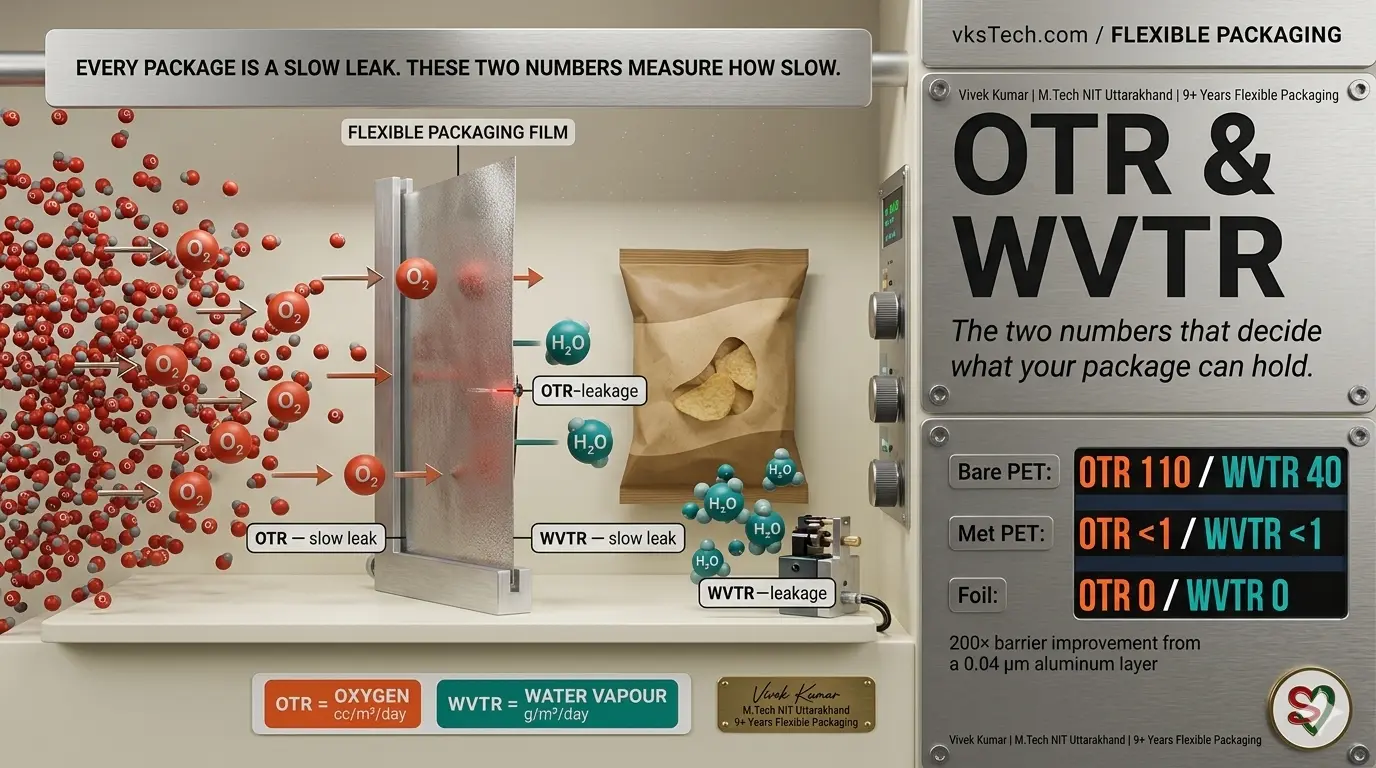
🛡️ OTR & WVTR — The Two Numbers That Decide What Your Package Can Hold
📖 14-min read | The Barrier Property Bible for Flexible Packaging Engineers | Published May 2026 | Includes dual-mode calculator + bookmark-able cheat sheet
Every flexible packaging conversation eventually arrives at the same two acronyms: OTR and WVTR. Customer asks for a barrier spec — they're really asking for OTR and WVTR. Procurement compares two suppliers' films — they're comparing OTR and WVTR. R&D evaluates a new substrate — they measure OTR and WVTR. Yet many operators on the shop floor have only the vaguest sense of what these numbers mean, what units they come in, and how to translate "I need to package this product for 12 months" into "the laminate needs OTR <1 and WVTR <1." This blog closes that gap. By the end you will know exactly what OTR and WVTR are, how they're measured, what values different substrates deliver, what values different food products require, and — using the calculator at the bottom — which structure to specify for any product. This is the page to bookmark and the cheat sheet to print.
🧪 What These Numbers Actually Mean
A package is a slow leak. Everything leaks — the question is how slowly, and whether the leak rate is slow enough to keep the product inside fresh until the consumer opens it. OTR and WVTR are the two numbers that quantify this leak rate for the two molecules that matter most in food preservation: oxygen (causes oxidation, rancidity in fats, aroma loss in coffee, fat bloom in chocolate) and water vapour (causes loss of crispness in chips, mold growth on bread, caking in spices, stickiness in toffee).
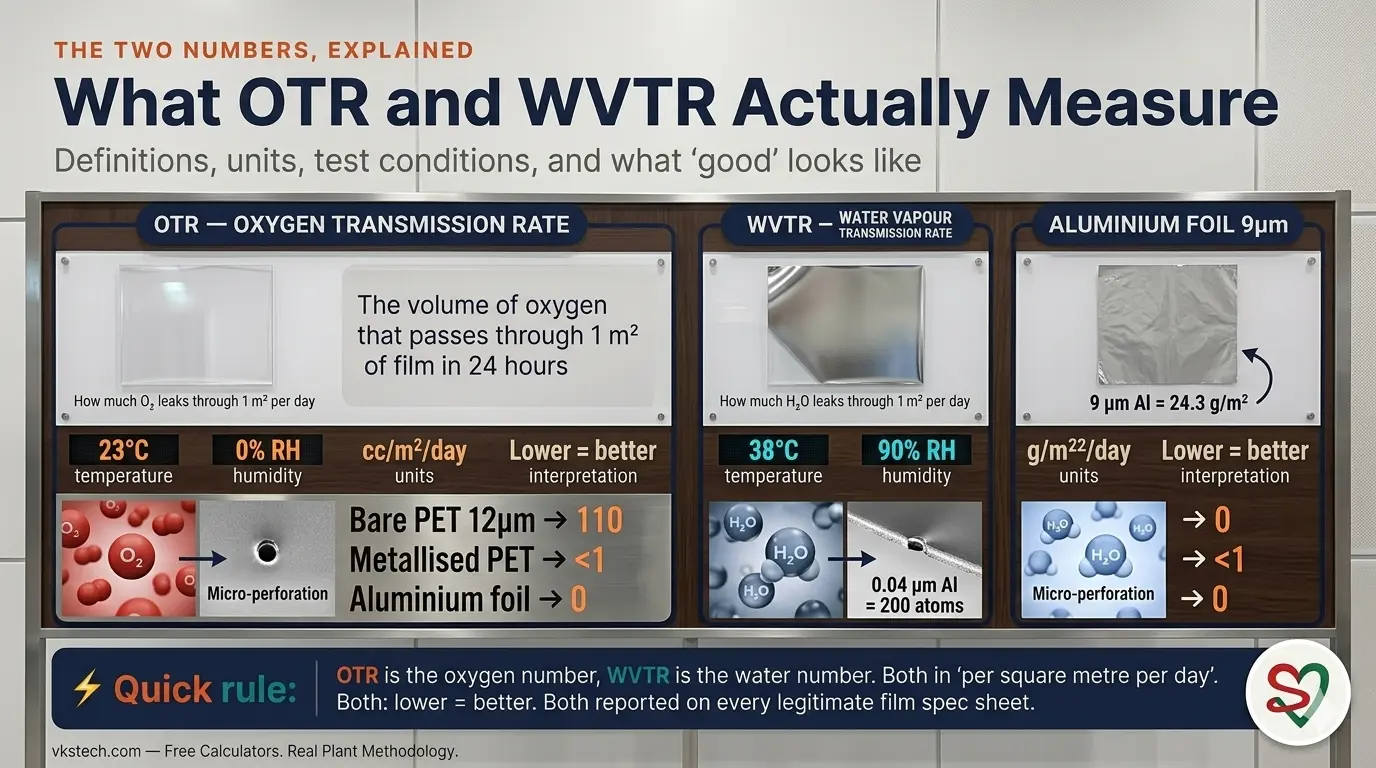
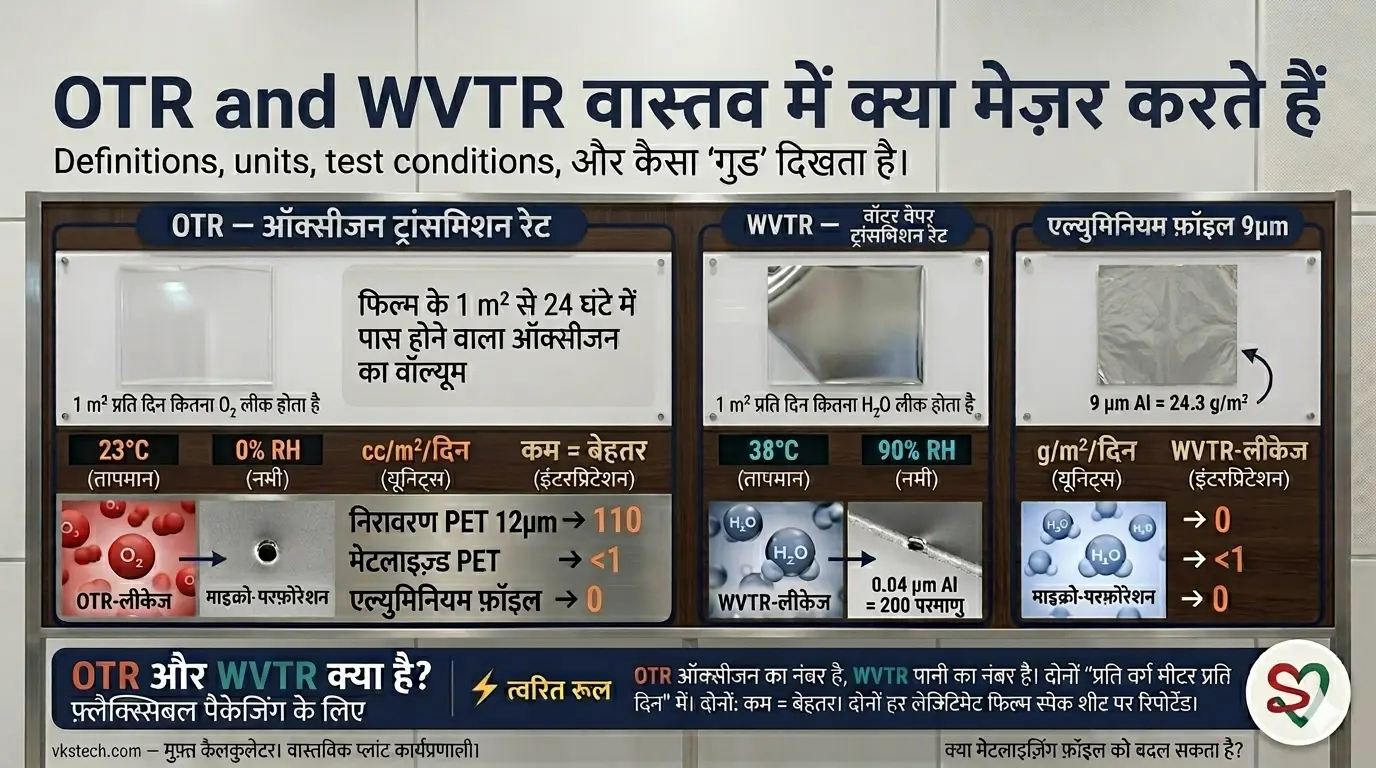
OTR — Oxygen Transmission Rate. The volume of oxygen, measured in cubic centimetres at standard temperature and pressure, that passes through 1 square metre of the packaging film in 24 hours, when the film is held at 23°C and 0% relative humidity, with one side exposed to pure oxygen and the other to a stream of inert gas. Standard unit: cc/m²/day. Sometimes written as cm³/m²/day or with the suffix "(STP)" for "standard temperature and pressure." Measured on a Mocon Ox-Tran or equivalent.
WVTR — Water Vapour Transmission Rate. The mass of water vapour, measured in grams, that passes through 1 square metre of the packaging film in 24 hours, when the film is held at 38°C (≈100°F) and 90% relative humidity, with one side exposed to high-humidity air and the other to dry desiccant. Standard unit: g/m²/day. Measured on a Mocon Permatran or by gravimetric cup methods (ASTM E96).
Both numbers are properties of the laminate as a whole, not just one layer. A 12-micron PET film bonded to a 50-micron LDPE sealant has a different OTR/WVTR than the PET alone — usually slightly worse, because the LDPE adds its own transmission to the path. The lowest-barrier layer in the structure dominates. If your beautiful Met PET has a microscopic pinhole, the entire laminate's barrier collapses to whatever the LDPE alone can provide.
📏 Why the Test Conditions Matter
The 23°C/0% RH for OTR and 38°C/90% RH for WVTR are not arbitrary. Both standards were chosen to represent realistic worst-case storage conditions for tropical markets and to give comparable numbers across labs and suppliers. But test conditions matter enormously for some materials:
| Material | OTR @ 50% RH | OTR @ 90% RH | Sensitivity |
|---|---|---|---|
| PET (bare) | ~110 | ~115 | Low — PET is humidity-stable |
| BOPP (bare) | ~2,400 | ~2,500 | Low |
| Metallised PET | ~0.5 | ~0.7 | Slight — Al layer is humidity-stable |
| EVOH | ~0.1 | ~0.3-1.0 | Severe — humidity tripled OTR or more |
| Nylon (BOPA) | ~40 | ~80-100 | Severe — humidity doubles OTR |
This is why a single OTR number on a spec sheet can mislead you. EVOH is the world's best oxygen barrier at 0% RH, and it's a mediocre one at 90% RH. If you're packaging a product for the Indian monsoon market, you cannot use the dry-condition OTR as your spec — you need the high-humidity number. Always ask your supplier for the test conditions, and always ask for the value at the humidity your product will actually see.
🔬 How They're Measured
Two main methods dominate industrial barrier testing: coulometric for OTR (Mocon Ox-Tran) and infrared sensor or gravimetric for WVTR (Mocon Permatran or cup method). The principle is the same in all cases: clamp a film sample in a chamber, expose one side to the test gas (O₂ or H₂O), put a sensor or absorbent on the other side, measure how much gas appears on the sensor side per unit time per unit area. The math gives you cc/m²/day or g/m²/day.
Most Indian lab houses charge ₹3,000-8,000 per OTR/WVTR test pair, with results in 5-10 days. SGS, Bureau Veritas, and ICMR-affiliated labs are the most-cited sources. For high-volume production, in-house Mocon machines are the norm at large converters — the capital cost runs ₹40-60 lakh per machine, but the running cost per test drops below ₹500.
One important caveat: barrier numbers from sales literature are usually "best-case lab conditions" — pristine film, no creases, no flex damage, optimal temperature control. Real-world flex-converted, printed, laminated, slit, rewound film typically delivers 1.5× to 3× higher OTR/WVTR than the lab number, because of pinholes from flex cracking, solvent retention from printing, and lamination defects. Always design with a 2× safety margin against the spec sheet number.
🍿 What Different Foods Actually Need
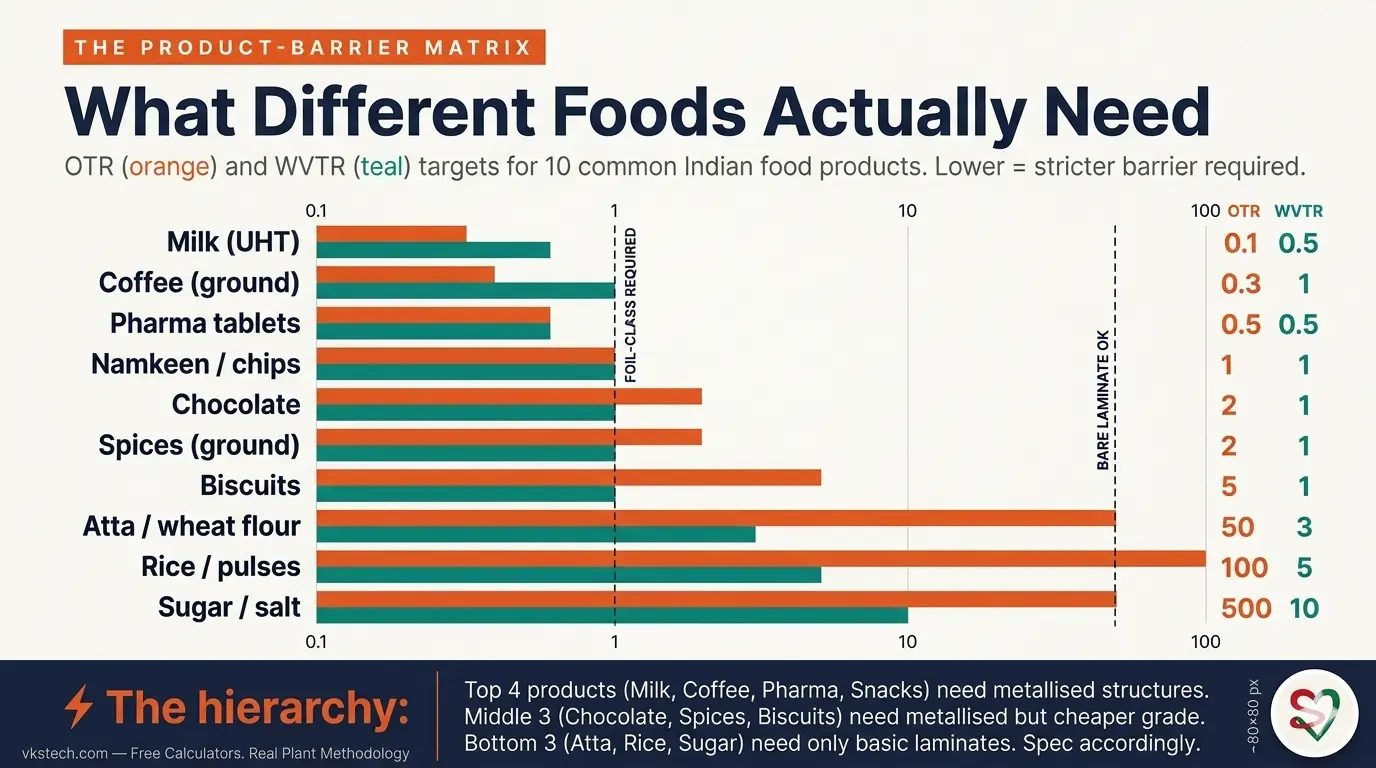
The barrier requirement comes from the product, not the package. Different foods have different sensitivities, different shelf-life targets, and different consequences of failure. The table below is the operator's bible — match the food category in column 1 to the OTR/WVTR target in columns 3-4, then use the calculator at the bottom to translate that into a structure recommendation.
| Food product | Target shelf life | Max OTR (cc/m²/day) | Max WVTR (g/m²/day) | Why this barrier |
|---|---|---|---|---|
| Milk (UHT, Tetra Pak) | 6 months | <0.1 | <0.5 | Sterility critical — even trace O₂ triggers spoilage |
| Coffee (ground) | 12 months | <0.3 | <1 | Aroma loss highly O₂-sensitive — high surface area |
| Pharma tablets | 24 months | <0.5 | <0.5 | Efficacy + sterility regulatory requirement |
| Coffee (whole bean) | 12 months | <0.5 | <2 | Aroma loss, less surface area than ground |
| Potato chips/namkeen | 6 months | <1 | <1 | Fat oxidation + crispness |
| Chocolate | 12 months | <2 | <1 | Fat bloom + aroma protection |
| Spices (ground) | 12 months | <2 | <1 | Aroma loss high, surface area large |
| Tea | 24 months | <2 | <1 | Flavour + moisture protection |
| Spices (whole) | 24 months | <5 | <2 | Aroma + moisture, lower surface area |
| Biscuits/cookies | 6 months | <5 | <1 | Crispness more critical than oxidation |
| Dry fruits | 12 months | <5 | <2 | Rancidity in oils + moisture |
| Cheese (vacuum) | 3 months | <5 | <5 | Mold prevention more than O₂ |
| Pet food (dry) | 12 months | <10 | <2 | Fat oxidation + insect prevention |
| Atta/wheat flour | 6 months | <50 | <3 | Insect + moisture, mainly mechanical |
| Pulses/dal | 12 months | <50 | <3 | Insect + moisture protection |
| Rice (parboiled) | 12 months | <100 | <5 | Insect + moisture, large grain |
| Sugar/salt | 24 months | <500 | <10 | Anti-caking only — barrier is secondary |
📋 Substrate Reference Table — All 16 Common Materials
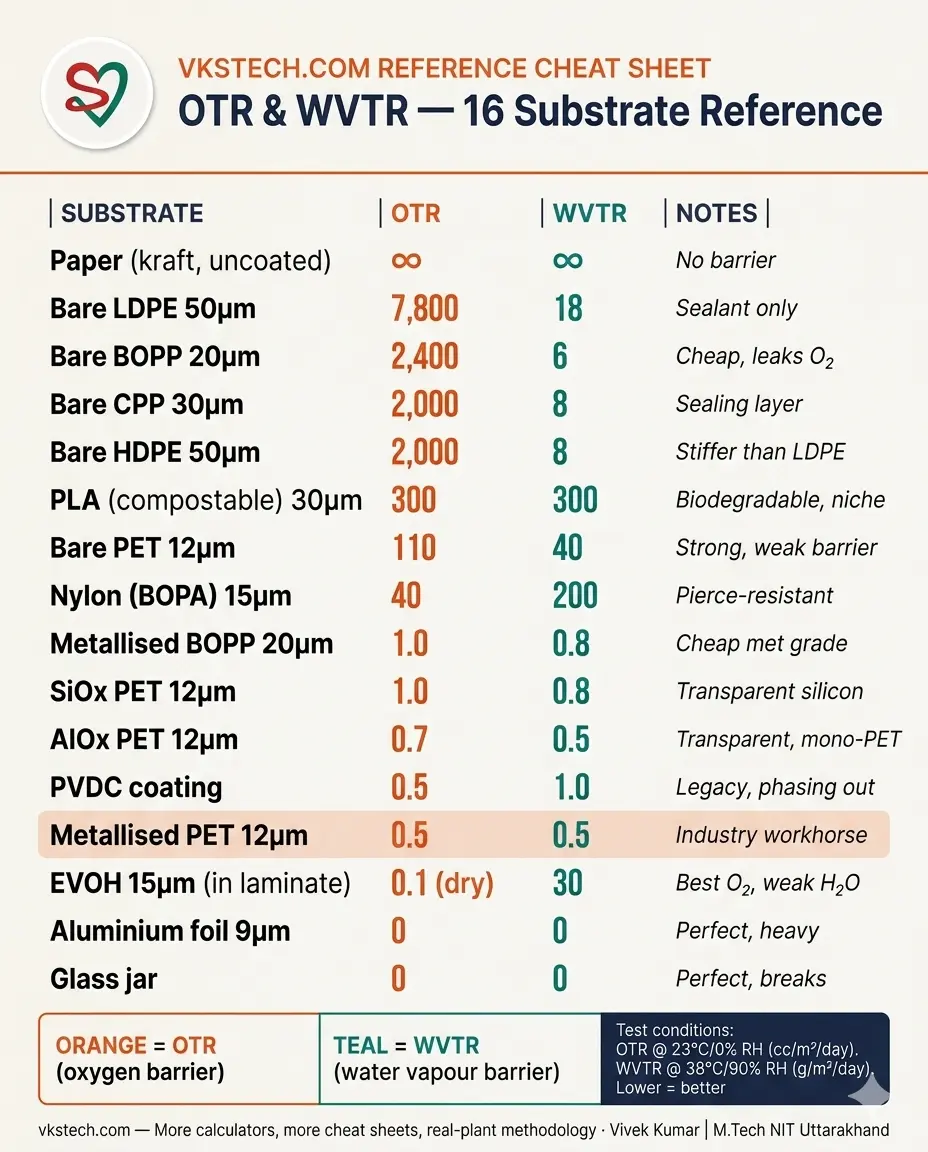
The other half of the equation. Match what you need (table above) to what materials can deliver (table below). The 16 substrates here cover virtually every flexible packaging structure in commercial use today. Note: values are approximate, vary by manufacturer, and assume standard test conditions.
| Substrate | OTR (cc/m²/day) | WVTR (g/m²/day) | Notes |
|---|---|---|---|
| Bare PET 12μm | ~110 | ~40 | Baseline polyester. Strong, dimensionally stable, weak barrier. |
| Bare BOPP 20μm | ~2,400 | ~6 | Cheap, clear, high O₂ leak, decent moisture barrier. |
| Bare CPP 30μm | ~2,000 | ~8 | Cast polypropylene. Sealing layer, weak barrier. |
| Bare LDPE 50μm | ~7,800 | ~18 | Standard sealant layer. No oxygen barrier. |
| Bare HDPE 50μm | ~2,000 | ~8 | Stiffer than LDPE, slightly better barrier. |
| Paper (kraft, uncoated) | essentially ∞ | essentially ∞ | No barrier without coating or lamination. |
| Glass jar | ~0 (absolute) | ~0 (absolute) | Perfect barrier. Heavy, breakable, not flexible. |
| Aluminium foil 9μm | ~0 (absolute) | ~0 (absolute) | Perfect. 24.3 g/m² Al. Heavy, expensive, creases. |
| Metallised PET 12μm | ~0.5 | ~0.5 | Foil-class barrier. 0.04μm Al. The industry workhorse. |
| Metallised BOPP 20μm | ~1.0 | ~0.8 | Cheaper than Met PET. Good for snacks. |
| AlOx PET 12μm | ~0.7 | ~0.5 | Transparent, mono-PET recyclable. EPR-friendly. |
| SiOx PET 12μm | ~1.0 | ~0.8 | Transparent silicon oxide. Alternative to AlOx. |
| EVOH 15μm (in laminate) | ~0.1 (dry) | ~30 | Best O₂ barrier when dry. Useless against moisture alone. |
| PVDC coating (legacy) | ~0.5 | ~1 | Being phased out due to chlorine content. |
| Nylon (BOPA) 15μm | ~40 | ~200 | Good O₂ barrier when dry. Terrible WVTR. Pierce/puncture resistance. |
| PLA (compostable) 30μm | ~300 | ~300 | Biodegradable, weak barrier. Niche only. |
⚠️ Six Common Spec Mistakes That Cost Real Money
Specifying barrier is one of those engineering tasks where small mistakes have big downstream consequences. The six errors below are responsible for the majority of barrier-related quality issues at flexible packaging plants:
1. Confusing units between standards. ASTM (American) tests OTR at 23°C/0% RH. JIS (Japanese) often uses 23°C/65% RH. DIN (European) sometimes uses 25°C/85% RH. The same film can show OTR values 10-30% apart depending on which standard. Always ask which standard your supplier used.
2. Quoting individual layer values for the laminate. A 3-layer laminate of PET (OTR 110) + Met PET (OTR 0.5) + LDPE (OTR 7800) has a laminate OTR closer to the Met PET value (~0.5-0.7), not the average of the layers. The lowest-barrier layer dominates — but pinholes in that layer can collapse the whole structure to the worst-barrier layer's value.
3. Forgetting humidity dependence. EVOH OTR can triple between dry and humid conditions. Nylon doubles. If your product ships through monsoon humidity, the dry-state spec is meaningless. Test at the humidity the product will actually see.
4. Over-specifying barrier. Specifying Met PET when Bare PET would do is the most common cost error in the Indian market. A 30g pouch of atta does not need OTR <1 — it needs OTR <50. The cost difference between Met PET-LDPE and BOPP-LDPE structures is ~30%. Across millions of pouches, that's lakhs per month wasted.
5. Confusing barrier with active oxygen scavenger. A barrier slows oxygen transmission from outside in. An oxygen scavenger (typically iron-based sachets or oxygen-absorbing polymers in the structure) removes oxygen already inside the package. They solve different problems. For long-shelf-life products like premium coffee, you typically need both.
6. Specifying barrier without product testing. The gold standard is Accelerated Shelf-Life Testing (ASLT) — pack the product in candidate structures, store at elevated temperature (40°C, 75% RH typical) for 4-12 weeks, then evaluate sensory and microbial parameters. This catches issues that pure barrier numbers miss: sealing defects, migration, off-flavour development. Spec barrier first, ASLT to confirm.
🧮 Calculator — Pick Your Mode
Two ways to use this calculator. Mode A (Product-driven) — pick a food product, get the barrier spec and recommended structure. Best for operators and customer-facing teams. Mode B (Spec-driven) — enter your own OTR/WVTR target, get the recommended structure. Best for advanced spec engineers and R&D. Both modes use the same recommendation engine.
💡 The Engineering Mindset
The right way to use OTR and WVTR is not to memorise specific values but to develop intuition for orders of magnitude. Numbers under 1 mean foil-class barrier — that's metallisation territory, expensive, premium products only. Numbers in the 1-10 range mean snack-class barrier — typical metallised structures. Numbers in the 10-100 range mean atta/dal-class barrier — bare laminates do the job. Numbers above 100 mean the barrier is essentially mechanical only — bulk grains, sugar, anything where the product itself isn't sensitive.
Once you have that intuition, the conversation with customers and procurement gets a lot more productive. Instead of "what barrier does the customer want?" you can ask "what shelf life does the product need, and at what storage conditions?" — and translate that into the OTR/WVTR target yourself. That's the engineer's value-add. The calculator above is a starting point; the intuition is what makes you indispensable.
📚 Related reads on this site: This blog explains what OTR and WVTR are. Blog #33 explains why metallisation exists as the barrier solution. Blog #31 covers the AlOx-vs-Metallised-PET decision once you've spec'd the barrier. Blog #30 handles the production-capacity side. Blog #28 handles the cost side.
Stuck on a specific food product not in the table above? Disagree with a barrier target? Want to discuss test method differences or your specific lab results? Drop your question in the Q&A section at the bottom of this page — I respond personally to every thoughtful pushback.
📌 What's next. Blog 35 will return to operations — OEE for Metallisers — combining the capacity engine (Blog 30), waste reduction (Blogs 24/26), and downtime tracking into a single number that survives any review meeting.
🛡️ OTR & WVTR — दो Numbers जो Decide करते हैं आपका Package क्या Hold कर सकता है
📖 14-min read | Flexible Packaging Engineers के लिए Barrier Property Bible | May 2026 में published | Dual-mode calculator + bookmark-able cheat sheet शामिल
हर flexible packaging conversation eventually उन्हीं दो acronyms पर आती है: OTR और WVTR। Customer barrier spec माँगे — असल में OTR और WVTR माँग रहा है। Procurement दो suppliers की films compare करे — OTR और WVTR compare कर रहा है। R&D नया substrate evaluate करे — OTR और WVTR measure कर रहा है। फिर भी shop floor पर बहुत operators को सिर्फ़ vague sense है कि ये numbers क्या मतलब रखते हैं, क्या units में आते हैं, और कैसे "मुझे ये product 12 महीने package करना है" को "laminate को OTR <1 और WVTR <1 चाहिए" में translate करें। ये blog वो gap close करता है। End तक आपको exactly पता होगा OTR और WVTR क्या हैं, कैसे measure होते हैं, different substrates क्या values देते हैं, different food products क्या values चाहते हैं, और — bottom पर calculator use करके — किसी भी product के लिए कौन सी structure spec करें। ये page bookmark करने वाला है और cheat sheet print करने वाली।
🧪 ये Numbers Actually क्या मतलब रखते हैं
Package एक slow leak है। सब कुछ leak करता है — सवाल ये है कितना slowly, और क्या leak rate इतना slow है कि product अंदर fresh रहे जब तक consumer खोले। OTR और WVTR वो दो numbers हैं जो उन दो molecules के लिए ये leak rate quantify करते हैं जो food preservation में सबसे ज़्यादा matter करते हैं: oxygen (oxidation cause करता है, fats में rancidity, coffee में aroma loss, chocolate में fat bloom) और water vapour (chips में crispness loss, bread पर mold growth, spices में caking, toffee में stickiness)।
OTR — Oxygen Transmission Rate। Oxygen का volume, standard temperature और pressure पर cubic centimetres में measured, जो 1 square metre packaging film से 24 hours में pass होता है, जब film 23°C और 0% relative humidity पर hold हो, एक side pure oxygen exposed और दूसरी inert gas के stream को। Standard unit: cc/m²/day। कभी-कभी cm³/m²/day लिखा जाता है या "(STP)" suffix के साथ "standard temperature and pressure" के लिए। Mocon Ox-Tran या equivalent पर measure।
WVTR — Water Vapour Transmission Rate। Water vapour का mass, grams में measured, जो 1 square metre packaging film से 24 hours में pass होता है, जब film 38°C (≈100°F) और 90% relative humidity पर hold हो, एक side high-humidity air exposed और दूसरी dry desiccant। Standard unit: g/m²/day। Mocon Permatran पर या gravimetric cup methods (ASTM E96) से measure।
दोनों numbers laminate के whole की properties हैं, सिर्फ़ एक layer की नहीं। 12-micron PET film जो 50-micron LDPE sealant से bonded है उसका OTR/WVTR PET अकेले से अलग होगा — usually slightly worse, क्योंकि LDPE अपनी transmission path में add करती है। Structure की lowest-barrier layer dominate करती है। अगर आपकी beautiful Met PET में microscopic pinhole है, पूरी laminate का barrier जो भी LDPE अकेले provide कर सके उसी पर collapse हो जाता है।
📏 Test Conditions क्यों Matter करते हैं
OTR के लिए 23°C/0% RH और WVTR के लिए 38°C/90% RH arbitrary नहीं हैं। दोनों standards tropical markets के लिए realistic worst-case storage conditions represent करने और labs/suppliers में comparable numbers देने के लिए चुने गए। पर test conditions कुछ materials के लिए enormously matter करती हैं:
| Material | OTR @ 50% RH | OTR @ 90% RH | Sensitivity |
|---|---|---|---|
| PET (bare) | ~110 | ~115 | Low — PET humidity-stable है |
| BOPP (bare) | ~2,400 | ~2,500 | Low |
| Metallised PET | ~0.5 | ~0.7 | Slight — Al layer humidity-stable है |
| EVOH | ~0.1 | ~0.3-1.0 | Severe — humidity OTR triple या ज़्यादा करती है |
| Nylon (BOPA) | ~40 | ~80-100 | Severe — humidity OTR double करती है |
यही reason है कि single OTR number spec sheet पर mislead कर सकता है। EVOH 0% RH पर world का best oxygen barrier है, और 90% RH पर mediocre। अगर आप Indian monsoon market के लिए product package कर रहे हैं, dry-condition OTR spec के रूप में नहीं use कर सकते — high-humidity number चाहिए। हमेशा supplier से test conditions पूछें, और product जिस humidity देखेगा उस पर value पूछें।
🔬 कैसे Measure होते हैं
Industrial barrier testing में दो main methods dominate करते हैं: coulometric OTR के लिए (Mocon Ox-Tran) और infrared sensor या gravimetric WVTR के लिए (Mocon Permatran या cup method)। Principle सब cases में same है: chamber में film sample clamp करो, एक side test gas (O₂ या H₂O) expose करो, दूसरी पर sensor या absorbent रखो, measure करो कितना gas sensor side पर per unit time per unit area आता है। Math आपको cc/m²/day या g/m²/day देता है।
Indian lab houses ज़्यादातर ₹3,000-8,000 per OTR/WVTR test pair charge करते हैं, results 5-10 दिन में। SGS, Bureau Veritas, और ICMR-affiliated labs सबसे ज़्यादा cited sources हैं। High-volume production के लिए, बड़े converters के पास in-house Mocon machines norm हैं — capital cost ₹40-60 lakh per machine, पर per-test running cost ₹500 से नीचे drop होती है।
एक important caveat: sales literature के barrier numbers usually "best-case lab conditions" होते हैं — pristine film, no creases, no flex damage, optimal temperature control। Real-world flex-converted, printed, laminated, slit, rewound film typically 1.5× से 3× higher OTR/WVTR deliver करती है lab number से, flex cracking pinholes, printing solvent retention, और lamination defects की वजह से। हमेशा spec sheet number के against 2× safety margin design करें।
🍿 Different Foods को Actually क्या चाहिए

Barrier requirement product से आती है, package से नहीं। Different foods की different sensitivities, different shelf-life targets, और failure के different consequences हैं। नीचे की table operator's bible है — column 1 में food category को columns 3-4 में OTR/WVTR target से match करें, फिर bottom पर calculator use करके उसे structure recommendation में translate करें।
| Food product | Target shelf life | Max OTR (cc/m²/day) | Max WVTR (g/m²/day) | क्यों ये barrier |
|---|---|---|---|---|
| Milk (UHT, Tetra Pak) | 6 months | <0.1 | <0.5 | Sterility critical — trace O₂ भी spoilage trigger करती है |
| Coffee (ground) | 12 months | <0.3 | <1 | Aroma loss highly O₂-sensitive — high surface area |
| Pharma tablets | 24 months | <0.5 | <0.5 | Efficacy + sterility regulatory requirement |
| Coffee (whole bean) | 12 months | <0.5 | <2 | Aroma loss, ground से कम surface area |
| Potato chips/namkeen | 6 months | <1 | <1 | Fat oxidation + crispness |
| Chocolate | 12 months | <2 | <1 | Fat bloom + aroma protection |
| Spices (ground) | 12 months | <2 | <1 | Aroma loss high, surface area बड़ा |
| Tea | 24 months | <2 | <1 | Flavour + moisture protection |
| Spices (whole) | 24 months | <5 | <2 | Aroma + moisture, lower surface area |
| Biscuits/cookies | 6 months | <5 | <1 | Crispness oxidation से ज़्यादा critical |
| Dry fruits | 12 months | <5 | <2 | Oils में rancidity + moisture |
| Cheese (vacuum) | 3 months | <5 | <5 | Mold prevention O₂ से ज़्यादा |
| Pet food (dry) | 12 months | <10 | <2 | Fat oxidation + insect prevention |
| Atta/wheat flour | 6 months | <50 | <3 | Insect + moisture, mainly mechanical |
| Pulses/dal | 12 months | <50 | <3 | Insect + moisture protection |
| Rice (parboiled) | 12 months | <100 | <5 | Insect + moisture, large grain |
| Sugar/salt | 24 months | <500 | <10 | Anti-caking only — barrier secondary है |
📋 Substrate Reference Table — सभी 16 Common Materials
Equation का दूसरा half। जो आपको चाहिए (ऊपर की table) उसे जो materials deliver कर सकते हैं (नीचे की table) से match करें। यहाँ 16 substrates virtually हर flexible packaging structure cover करते हैं जो commercial use में हैं। Note: values approximate हैं, manufacturer से vary करती हैं, और standard test conditions assume करती हैं।
| Substrate | OTR (cc/m²/day) | WVTR (g/m²/day) | Notes |
|---|---|---|---|
| Bare PET 12μm | ~110 | ~40 | Baseline polyester। Strong, dimensionally stable, weak barrier। |
| Bare BOPP 20μm | ~2,400 | ~6 | सस्ता, clear, high O₂ leak, decent moisture barrier। |
| Bare CPP 30μm | ~2,000 | ~8 | Cast polypropylene। Sealing layer, weak barrier। |
| Bare LDPE 50μm | ~7,800 | ~18 | Standard sealant layer। No oxygen barrier। |
| Bare HDPE 50μm | ~2,000 | ~8 | LDPE से stiffer, slightly better barrier। |
| Paper (kraft, uncoated) | essentially ∞ | essentially ∞ | Coating या lamination के बिना no barrier। |
| Glass jar | ~0 (absolute) | ~0 (absolute) | Perfect barrier। Heavy, breakable, flexible नहीं। |
| Aluminium foil 9μm | ~0 (absolute) | ~0 (absolute) | Perfect। 24.3 g/m² Al। Heavy, expensive, creases। |
| Metallised PET 12μm | ~0.5 | ~0.5 | Foil-class barrier। 0.04μm Al। Industry workhorse। |
| Metallised BOPP 20μm | ~1.0 | ~0.8 | Met PET से सस्ता। Snacks के लिए good। |
| AlOx PET 12μm | ~0.7 | ~0.5 | Transparent, mono-PET recyclable। EPR-friendly। |
| SiOx PET 12μm | ~1.0 | ~0.8 | Transparent silicon oxide। AlOx का alternative। |
| EVOH 15μm (in laminate) | ~0.1 (dry) | ~30 | Best O₂ barrier जब dry। Moisture के against अकेले useless। |
| PVDC coating (legacy) | ~0.5 | ~1 | Chlorine content की वजह से phased out हो रहा है। |
| Nylon (BOPA) 15μm | ~40 | ~200 | Good O₂ barrier जब dry। Terrible WVTR। Pierce/puncture resistance। |
| PLA (compostable) 30μm | ~300 | ~300 | Biodegradable, weak barrier। Niche only। |
⚠️ Real Money Cost करने वाली छह Common Spec Mistakes
Barrier specify करना उन engineering tasks में से एक है जहाँ छोटी mistakes बड़े downstream consequences रखती हैं। नीचे की छह errors flexible packaging plants पर majority barrier-related quality issues के लिए responsible हैं:
1. Standards के बीच units confuse करना। ASTM (American) OTR 23°C/0% RH पर test करता है। JIS (Japanese) अक्सर 23°C/65% RH use करता है। DIN (European) कभी 25°C/85% RH। Same film 10-30% apart OTR values show कर सकती है depending on standard। हमेशा supplier से पूछें कौन सा standard use किया।
2. Laminate के लिए individual layer values quote करना। 3-layer laminate of PET (OTR 110) + Met PET (OTR 0.5) + LDPE (OTR 7800) का laminate OTR Met PET value (~0.5-0.7) के closer है, layers का average नहीं। Lowest-barrier layer dominate करती है — पर उस layer में pinholes whole structure को worst-barrier layer की value पर collapse कर सकते हैं।
3. Humidity dependence भूलना। EVOH OTR dry और humid conditions के बीच triple हो सकती है। Nylon double हो जाती है। अगर आपका product monsoon humidity ship होता है, dry-state spec meaningless है। Product जिस humidity देखेगा उस पर test करें।
4. Barrier over-specify करना। Met PET specify करना जब Bare PET काम करेगी Indian market में सबसे common cost error है। 30g pouch of आटा को OTR <1 नहीं चाहिए — OTR <50 चाहिए। Met PET-LDPE और BOPP-LDPE structures के बीच cost difference ~30% है। Millions of pouches पर, वो lakhs per month wasted।
5. Barrier और active oxygen scavenger confuse करना। Barrier oxygen transmission outside से inside slow करता है। Oxygen scavenger (typically iron-based sachets या oxygen-absorbing polymers structure में) oxygen को remove करता है जो already inside package है। वो different problems solve करते हैं। Long-shelf-life products जैसे premium coffee के लिए, typically दोनों चाहिए।
6. Product testing के बिना barrier specify करना। Gold standard है Accelerated Shelf-Life Testing (ASLT) — product को candidate structures में pack करो, elevated temperature (40°C, 75% RH typical) पर 4-12 weeks store करो, फिर sensory और microbial parameters evaluate करो। ये उन issues को catch करता है जो pure barrier numbers miss करते हैं: sealing defects, migration, off-flavour development। Barrier पहले spec करो, ASLT confirm करने के लिए।
🧮 Calculator — अपना Mode Pick करें
इस calculator को use करने के दो ways। Mode A (Product-driven) — food product pick करें, barrier spec और recommended structure मिलेगा। Operators और customer-facing teams के लिए best। Mode B (Spec-driven) — अपना OTR/WVTR target enter करें, recommended structure मिलेगा। Advanced spec engineers और R&D के लिए best। दोनों modes same recommendation engine use करते हैं।
💡 Engineering Mindset
OTR और WVTR use करने का सही way specific values memorise करना नहीं है पर orders of magnitude के लिए intuition develop करना है। 1 के नीचे numbers मतलब foil-class barrier — वो metallisation territory, expensive, premium products only। 1-10 range के numbers मतलब snack-class barrier — typical metallised structures। 10-100 range मतलब atta/dal-class barrier — bare laminates काम करते हैं। 100 के ऊपर मतलब barrier essentially mechanical only — bulk grains, sugar, कुछ भी जहाँ product itself sensitive नहीं।
एक बार वो intuition आ गई, customers और procurement के साथ conversation बहुत productive हो जाती है। "Customer क्या barrier चाहता है?" के बजाय आप पूछ सकते हैं "product को क्या shelf life चाहिए, और क्या storage conditions पर?" — और उसे OTR/WVTR target में खुद translate कर सकते हैं। वो engineer का value-add है। ऊपर का calculator starting point है; intuction वो है जो आपको indispensable बनाती है।
📚 इस site पर related reads: ये blog explain करता है क्या OTR और WVTR हैं। Blog #33 explain करता है क्यों metallisation barrier solution के रूप में exist करती है। Blog #31 AlOx-vs-Metallised-PET decision cover करता है barrier spec करने के बाद। Blog #30 production-capacity side handle करता है। Blog #28 cost side handle करता है।
ऊपर table में नहीं किसी specific food product पर stuck हैं? Barrier target से disagree करते हैं? Test method differences या अपने specific lab results discuss करना चाहते हैं? अपना सवाल इस page के bottom पर Q&A section में डालें — मैं हर thoughtful pushback का personally जवाब देता हूँ।
📌 आगे क्या। Blog 35 operations पर वापस जाएगा — Metallisers के लिए OEE — capacity engine (Blog 30), waste reduction (Blogs 24/26), और downtime tracking को एक single number में combine करता है जो किसी भी review meeting को survive करे।