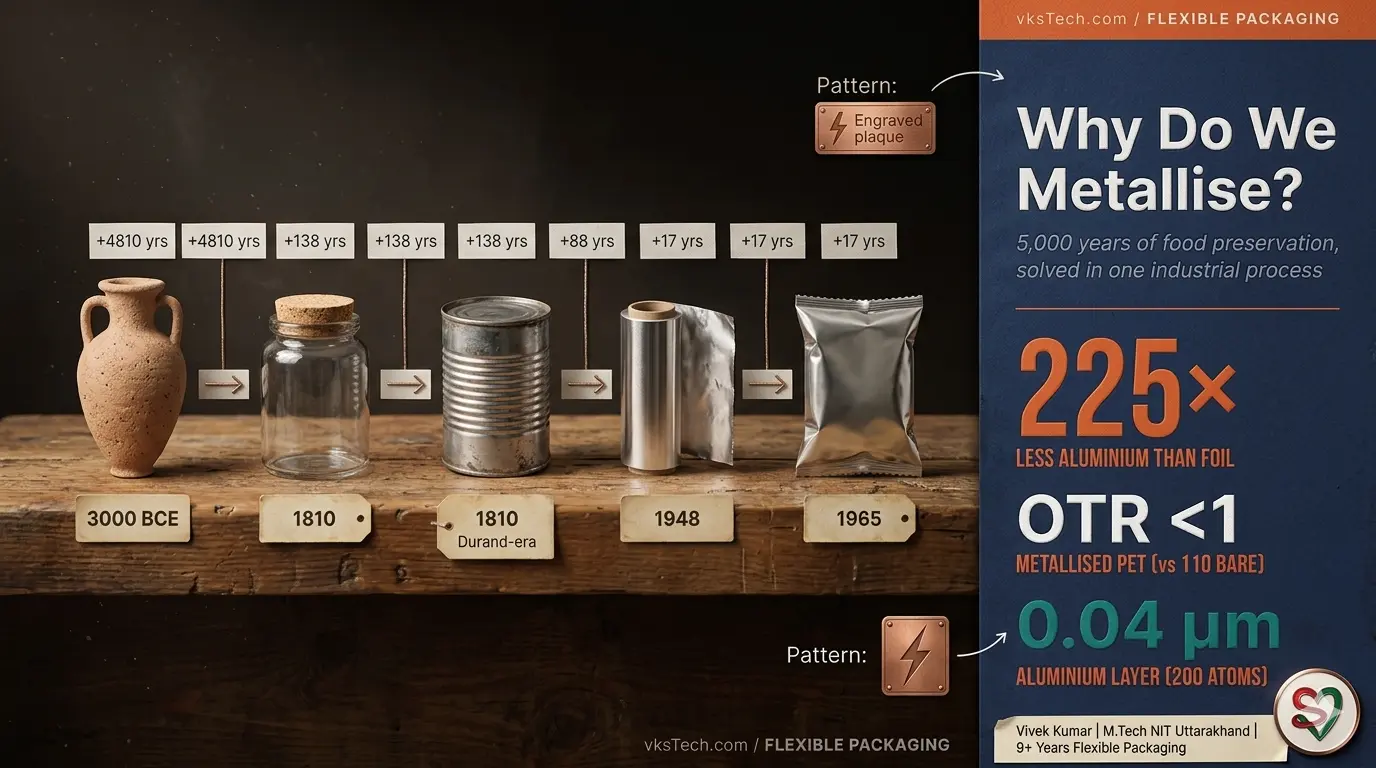
🪙 Why Do We Metallise? From Clay Pots to 12-Micron Foil-Class Films
📖 11-min read | 5,000 Years of Food Preservation, Solved in One Industrial Process | Published May 2026
Every flexible packaging engineer has been asked the same question by a non-industry friend at some point: "Why do you put aluminium on plastic? Why not just use foil? Or just plastic?" The honest answer is that the entire packaging industry took 5,000 years to converge on metallised film, because every other approach failed at one or more of three constraints — barrier, weight, and cost. This blog walks through that 5,000-year evolution and lands on the engineering miracle that is vacuum metallisation: a process that gives you the barrier of aluminium foil with 225 times less aluminium, at one-tenth the weight, at a fraction of the cost. By the end you will understand why metallisation is not a compromise — it is the answer the industry was looking for since 3000 BCE.
📜 5,000 Years of the Same Problem
Food preservation is one of humanity's oldest engineering problems. The basic challenge has not changed in 5,000 years: keep oxygen out, keep moisture out, keep light out, keep the food safe and edible for as long as possible — and do it cheaply enough that ordinary people can afford it. Every civilisation that fed itself solved versions of this problem with whatever materials it had.
The Egyptians sealed clay pots with beeswax around 3000 BCE — the first true food-storage technology. Beeswax gave a moisture barrier; the clay gave structural protection. The Romans added bronze and copper containers, with the side effect of slow metal poisoning that nobody understood for centuries. The Indian subcontinent independently developed earthen pots, copper kalash, and oil-based preservation (achaar in mustard oil being a 2,000-year-old example of using fat as an oxygen barrier).
Each of these solutions worked — for the food, the geography, and the economic level it was designed for. None of them scaled to feed an industrial society of a billion people across a 3,000-kilometre supply chain. That problem is younger than 200 years, and the materials that solved it are younger than 100.
🧪 The Industrial Revolution — Glass, Tin, and Pasteur
The first real breakthrough in modern food preservation was prize-driven. In 1795, Napoleon offered 12,000 francs to anyone who could solve the problem of feeding his army on long campaigns. Nicolas Appert won it in 1810 with a method that hasn't fundamentally changed since: heat the food in a sealed glass jar, let air pressure form the seal as it cools. Glass jars gave a perfect oxygen and moisture barrier. They also weighed 200-400 grams per jar, broke easily, were expensive to produce, and were impossible to ship in volume to remote villages.
The same year, Peter Durand patented the tin-coated steel can in the UK. Cans solved the breakage problem and improved the freight economics, but they introduced new ones: heavy, expensive to manufacture, required specialised equipment to open, and the tin coating still added weight to every shipment. The first generation of cans weighed more than 100 grams empty, for less than 500 grams of food.
By the 1850s, Louis Pasteur's work on microorganisms gave the industry the scientific foundation it had been operating on intuitively. Now everyone understood why sealing matters — bacteria, mold, oxidation, and water activity are the four enemies, and packaging is the first line of defense. The next 60 years would be a search for materials that could deliver the barrier of glass and tin at a fraction of the weight and cost.
⚗️ The Polymer Revolution — 1908 to 1965
Modern flexible packaging is a 20th-century invention. Four discoveries made it possible, all of them either accidental or unrelated to packaging at the time:
| Year | Discovery | What it changed |
|---|---|---|
| 1908 | Cellophane (Jacques Brandenberger) | First transparent flexible film. Originally invented to protect tablecloths from wine stains. Adopted by the food industry within a decade. |
| 1933 | Polyethylene (ICI, accidentally) | ICI chemists were running ethylene experiments under high pressure when a leak in their reactor produced a waxy white solid. The world's most-produced plastic was born. |
| 1948 | Aluminium foil commercialised | Reynolds Wrap and others made household and industrial foil widely available. Perfect barrier — but heavy, expensive, and creased on flex. |
| 1952 | PET (Whinfield & Dickson) | Polyester film. Strong, transparent, dimensionally stable. The substrate that would later carry vacuum-deposited aluminium for the next 70 years. |
By the early 1960s, the industry had three good materials but no perfect one. Polyethylene was cheap and a great moisture barrier but useless against oxygen. PET was strong and clear but a poor barrier on its own. Aluminium foil was perfect but expensive, heavy, and prone to micro-cracks at every fold. Multilayer laminates (paper-foil-poly) gave good performance but used a lot of material. The industry needed something that combined the barrier of foil with the flexibility and cost of plastic film.
⚡ 1965 — The Vacuum Metalliser Arrives
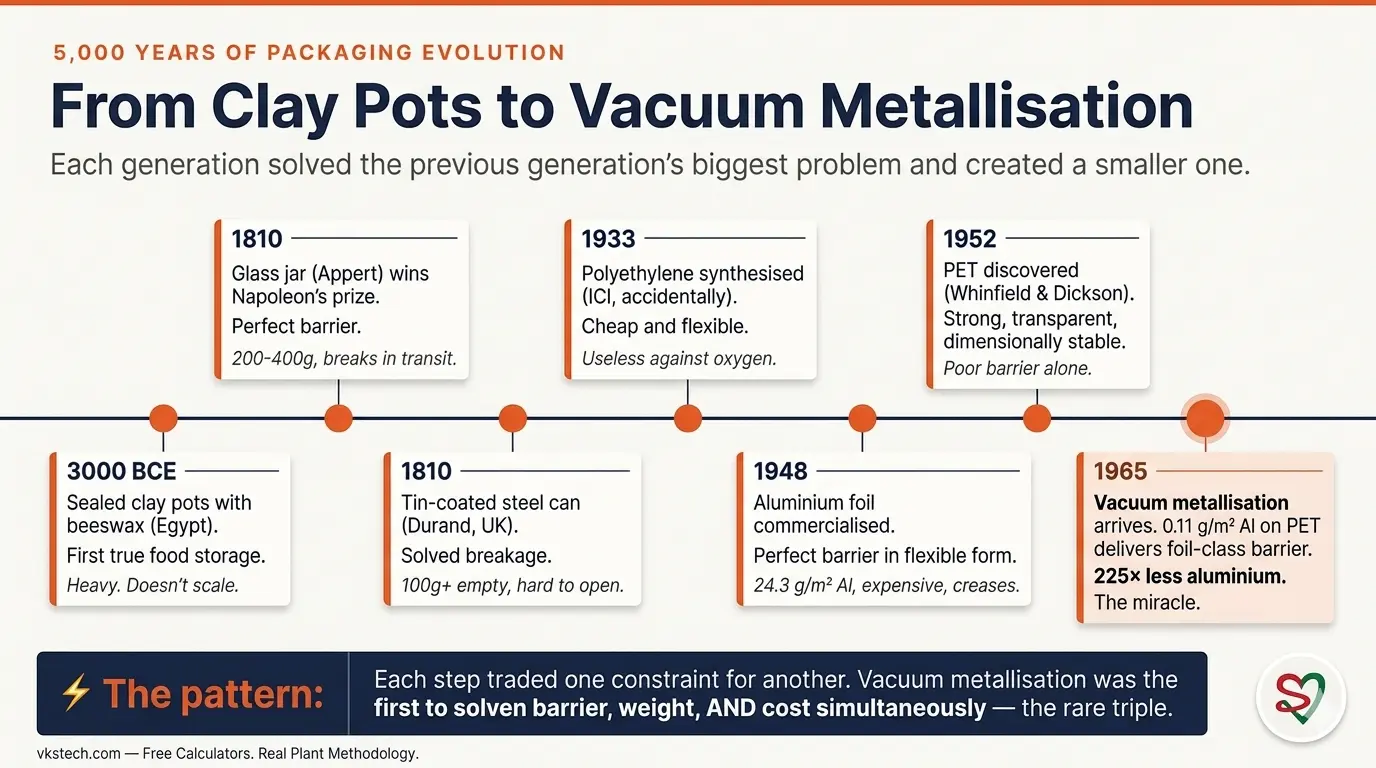
Vacuum metallisation as a commercial process became viable around 1965, and it was the answer the industry had been searching for. The principle is straightforward: heat solid aluminium to about 1500°C inside a vacuum chamber until it vaporises, then let the aluminium vapour condense onto a moving plastic film. The deposited aluminium layer is microscopically thin — typically 40 nanometres, which is 0.04 microns, which is roughly 200 atoms thick. Yet that infinitesimal layer reduces the oxygen transmission of the underlying PET by a factor of 200, and the moisture transmission by a factor of 80.
The economics were transformative. True aluminium foil at 9 microns uses 24.3 grams of aluminium per square metre. Metallised PET at 40 nanometres uses 0.11 grams per square metre. The barrier is essentially identical. The aluminium consumption is 225 times lower. The film remains flexible, transparent (silver-grey rather than fully opaque), heat-sealable, and printable. For the first time, the industry had a material that could deliver foil-class barrier at plastic-class economics.
A 200-atom-thick layer of vapour-deposited aluminium gives a 12-micron PET film the same barrier performance as a 9-micron aluminium foil — using 225 times less aluminium, weighing one-tenth as much, at a fraction of the cost. Almost everything else about how India eats today is downstream of this single industrial achievement.
📊 Why It Matters — The Barrier Numbers
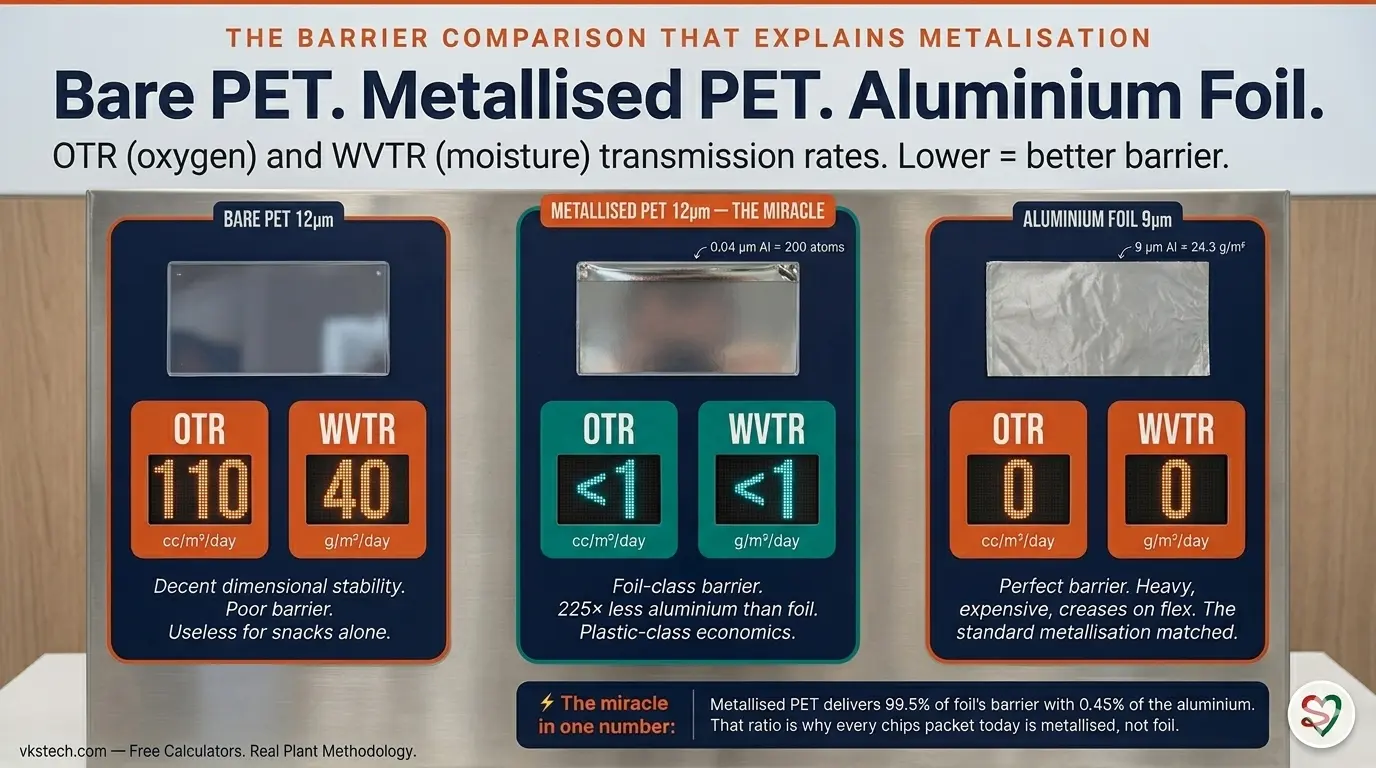
The two numbers that decide whether a package works or fails are OTR (Oxygen Transmission Rate) and WVTR (Water Vapour Transmission Rate). OTR is measured in cc/m²/day at 23°C, 50% RH. WVTR in g/m²/day at 38°C, 90% RH. Lower numbers mean better barrier. The next blog in this series — Blog 34 — is a complete explainer of these two numbers and how to spec them. For now, the comparison table below is the part that matters for understanding why metallisation matters:
| Substrate | OTR (cc/m²/day) | WVTR (g/m²/day) | Verdict |
|---|---|---|---|
| Bare PET 12μm | ~110 | ~40 | Decent dimensional stability, poor barrier |
| Bare BOPP 20μm | ~2,400 | ~6 | Good moisture, terrible oxygen |
| Bare LDPE 50μm | ~7,800 | ~18 | Good moisture, no oxygen barrier |
| Paper (kraft) | essentially infinite | essentially infinite | No barrier without coating or lamination |
| Metallised PET 12μm | ~0.5 | ~0.5 | Foil-class — 200× better than bare PET |
| AlOx PET 12μm (transparent) | ~0.7 | ~0.5 | Mono-material recyclable, similar barrier |
| Aluminium foil 9μm | ~0 (absolute) | ~0 (absolute) | Perfect — heavy, expensive, creases |
| Glass jar | ~0 (absolute) | ~0 (absolute) | Perfect — heavy, breaks |
The table tells the entire story. Plain plastic films, however cheap and flexible, leak. Glass and foil are perfect but pay heavy penalties in weight, cost, and freight. Metallised PET sits in the rare zone where barrier meets flexibility meets affordability — and that combination is what allowed flexible packaging to scale from being a luxury format in the West in the 1980s to being the dominant format in India today.
🇮🇳 The India Story — Why Metallisation Matched This Country's Geography
The reason metallised film deployed so heavily in India is not coincidence. India's geography and economics presented a packaging problem no other country had to solve at the same scale. The food supply chain runs from a single factory to villages 2,000 kilometres away across roads that wash out twice a year, transit temperatures that hit 45°C, humidity that exceeds 90% in monsoon, and consumer price points where every paisa of packaging cost matters because the food itself sells at ₹2 per gram.
Glass and tin were not affordable at this scale. Bare plastic films failed the barrier test in monsoon. Aluminium foil was too expensive and freight-inefficient for mass-market snacks. The only material that delivered the barrier required to keep a 30-gram namkeen pouch fresh from a Noida factory to a Bihar village for six months — at a cost of 30 paise per pouch — was metallised PET. The Indian flexible packaging industry that scaled in the 1990s and 2000s was, in a real sense, built on this single material innovation.
The downstream effects are visible at every kirana counter. The branded snacks, biscuits, namkeen, and confectionery that reach tier-3 and tier-4 towns today reach there because someone, in 1965, figured out how to deposit 200 atoms of aluminium onto a plastic film inside a vacuum chamber. That is the literal causal chain.
⚖️ The Trade-off Metallisation Created
Metallisation solved the barrier problem so completely that it created a new problem the industry is still working through: recyclability. A metallised PET pouch is technically a multi-material laminate (PET + aluminium + sealant) and falls into the EPR Category III bucket — the hardest to recycle, the most expensive to dispose of post-use. The Indian EPR Amendment Rules effective April 1, 2026 raised this cost from negligible to roughly ₹17.50 per kg of MLP put on the market.
The industry's response is the shift to mono-material structures — particularly AlOx-coated PET, which delivers ~95% of metallised PET's barrier with full mono-PET recyclability (EPR Category II, ~₹4 per kg). I covered this trade-off in detail in Blog #31 — the four-lens framework for choosing between metallised PET and AlOx, and when each makes sense for which product line.
The point worth understanding here is that the problem metallisation solved is bigger than the problem it created. Metallisation gave us 60 years of food security at scale. The recyclability problem is real and being solved. The history of packaging materials is a history of each generation solving the previous generation's biggest problem and creating a smaller one. We are in that cycle now. AlOx and the mono-material future will probably be the next chapter, with their own trade-offs that someone will write about in 2050.
🔬 What Metallisation Actually Needs — The Process in One Page
The vacuum metallisation process at a real plant comes down to four stages, each with its own engineering constraints:
| Stage | What happens | Why it matters |
|---|---|---|
| 1. Vacuum | Chamber pumped to 10⁻⁴ mbar (basically space) | Without vacuum, aluminium oxidises mid-flight and never reaches the film. Below 10⁻⁴ mbar, mean free path of Al atoms exceeds chamber dimensions. |
| 2. Boat heating | Ceramic boats heated to ~1,500°C | Aluminium melts at 660°C but vapour pressure only becomes useful around 1,400°C. Above 1,600°C and the boats burn out. |
| 3. Vapour deposition | Al vapour rises, condenses on moving film at 600-800 m/min | Film passes 30-50cm above boats. Deposit thickness controlled by line speed (slower = thicker), boat current (higher = more vapour). |
| 4. Cooling + winding | Film cooled by chill drum, rewound under tension | Hot film deposits would distort. Tension control prevents telescoping or starring on the rewind. |
The economics of running this process at industrial scale — boat life, source cleaning frequency, vacuum pump-down time, capacity planning — are exactly what the rest of this site is about. Blog #30 walks through the rolls-per-day calculation. Blog #29 covers the equivalent factor for different substrates. Blog #28 handles the cost equation. The why-we-do-this story ends here. The how-we-do-this story is in those technical blogs.
🎯 The Answer to the Question
So why do we metallise? Because in the 5,000-year arc of human food preservation, no other material has delivered foil-class barrier at plastic-class economics. Glass jars work but they break. Tin cans work but they're heavy. Aluminium foil works but it costs 225× more aluminium than necessary. Plain plastic films are cheap and flexible but they leak. Metallisation is the rare material technology that solves all three constraints at once — barrier, weight, and cost — and that solution is what allowed a billion Indians to access branded packaged food across a continental supply chain at an affordable price.
It is not the perfect packaging. Mono-material structures will probably be the next chapter. The recyclability problem is real and being addressed by the EPR transition. But for the food security gains delivered between 1980 and today, metallisation deserves the credit it rarely gets in public conversation. The next time you open a 30-gram pouch of namkeen, the silver-grey shine on the inside is 200 atoms of aluminium that travelled from a vacuum chamber to your kitchen, in service of a 5,000-year-old human problem. That is worth understanding.
📚 Related reads on this site: This blog explains why metallisation exists. The how is in the operations series — see Blog #30 for the rolls-per-day capacity calculation, Blog #28 for conversion cost, Blog #31 for the AlOx vs Metallised PET / EPR-recyclability decision, and Blog #32 for why polyethylene packaging is a net positive for food security despite the disposal problem.
Curious about a specific food category and what barrier it really needs? Want to discuss whether AlOx will fully replace metallised PET, or where each will dominate? Drop your question in the Q&A section at the bottom of this page — I respond personally to every thoughtful pushback.
📌 What's next. Blog 34 will be the technical companion to this one — Barrier Properties: OTR & WVTR Explained — a deep dive into the two numbers that decide what every package can and cannot hold, with a calculator that recommends the right barrier structure for any food category.
🪙 हम Metallise क्यों करते हैं? Clay Pots से 12-Micron Foil-Class Films तक
📖 11-min read | 5,000 साल का Food Preservation, एक Industrial Process में Solve | May 2026 में published
हर flexible packaging engineer को कभी न कभी non-industry friend ने एक ही सवाल पूछा है: "आप plastic पर aluminium क्यों लगाते हो? सिर्फ़ foil क्यों नहीं? या सिर्फ़ plastic क्यों नहीं?" Honest answer ये है कि पूरी packaging industry को 5,000 साल लगे metallised film पर converge करने में, क्योंकि हर दूसरा approach तीन constraints में से एक या ज़्यादा पर fail हुआ — barrier, weight, और cost। ये blog उस 5,000 साल के evolution के through walk करता है और land करता है उस engineering miracle पर जो vacuum metallisation है: एक process जो आपको aluminium foil जैसा barrier देता है 225 गुना कम aluminium के साथ, एक-दसवें weight पर, fraction of cost पर। End तक आप समझ जाएँगे कि metallisation compromise नहीं है — ये वो answer है जो industry 3000 BCE से ढूँढ रही थी।
📜 5,000 साल, वही Problem
Food preservation मानव की सबसे पुरानी engineering problems में से एक है। Basic challenge 5,000 साल में नहीं बदली: oxygen बाहर रखो, moisture बाहर रखो, light बाहर रखो, food को safe और edible रखो जितना लंबा हो सके — और इतना सस्ता करो कि आम लोग afford कर सकें। हर civilisation जिसने खुद को feed किया उसने इस problem के versions solve किए जो भी materials उसके पास थे।
Egyptians ने clay pots को beeswax से seal किया लगभग 3000 BCE — पहली true food-storage technology। Beeswax ने moisture barrier दिया; clay ने structural protection। Romans ने bronze और copper containers add किए, slow metal poisoning के side effect के साथ जिसे सदियों तक कोई समझ नहीं पाया। Indian subcontinent ने independently earthen pots, copper kalash, और oil-based preservation develop किए (mustard oil में achaar 2,000 साल पुराना example है fat को oxygen barrier की तरह use करने का)।
इन solutions में से हर एक काम करता था — उस food, geography, और economic level के लिए जिसके लिए design था। None of them एक billion लोगों की industrial society को 3,000-kilometre supply chain के across feed करने में scale हुए। वो problem 200 साल से छोटी है, और जिन materials ने उसे solve किया वो 100 साल से छोटे हैं।
🧪 Industrial Revolution — Glass, Tin, और Pasteur
Modern food preservation में पहला real breakthrough prize-driven था। 1795 में, Napoleon ने 12,000 francs offer किए किसी को भी जो लंबे campaigns पर अपनी army को feed करने की problem solve करे। Nicolas Appert ने 1810 में जीता एक method से जो fundamentally नहीं बदली है: food को sealed glass jar में heat करो, air pressure को seal बनाने दो जैसे वो cool हो। Glass jars ने perfect oxygen और moisture barrier दिया। उन्होंने 200-400 grams per jar weight भी किया, easily टूटे, produce करने में expensive थे, और remote villages में volume में ship करना impossible था।
उसी साल, Peter Durand ने UK में tin-coated steel can patent किया। Cans ने breakage problem solve की और freight economics improve की, पर नई problems introduce कीं: heavy, manufacture में expensive, खोलने के लिए specialised equipment चाहिए, और tin coating हर shipment में weight add करती। Cans की पहली generation 100 grams से ज़्यादा empty weight करती थी, 500 grams से कम food के लिए।
1850s तक, Louis Pasteur के microorganisms पर काम ने industry को scientific foundation दी जिस पर वो intuitively operate कर रही थी। अब हर कोई समझता था क्यों sealing matter करती है — bacteria, mold, oxidation, और water activity चार enemies हैं, और packaging first line of defense है। अगले 60 साल materials की search होगी जो glass और tin का barrier deliver करें fraction of weight और cost पर।
⚗️ Polymer Revolution — 1908 से 1965
Modern flexible packaging 20वीं सदी का invention है। चार discoveries ने possible बनाया, सब या तो accidental या उस वक़्त packaging से unrelated:
| साल | Discovery | क्या बदला |
|---|---|---|
| 1908 | Cellophane (Jacques Brandenberger) | पहली transparent flexible film। Originally tablecloths को wine stains से protect करने के लिए invent हुई। Food industry ने एक decade में adopt की। |
| 1933 | Polyethylene (ICI, accidentally) | ICI chemists high pressure पर ethylene experiments चला रहे थे जब उनके reactor में leak ने waxy white solid produce किया। World की सबसे ज़्यादा-produce होने वाली plastic पैदा हुई। |
| 1948 | Aluminium foil commercialised | Reynolds Wrap और दूसरों ने household और industrial foil widely available बनाई। Perfect barrier — पर heavy, expensive, और flex पर crease होती है। |
| 1952 | PET (Whinfield & Dickson) | Polyester film। Strong, transparent, dimensionally stable। वो substrate जो बाद में अगले 70 साल vacuum-deposited aluminium carry करेगी। |
1960s के early तक, industry के पास तीन good materials थे पर कोई perfect नहीं। Polyethylene सस्ती और great moisture barrier थी पर oxygen के against useless। PET strong और clear थी पर खुद barrier weak। Aluminium foil perfect था पर expensive, heavy, और हर fold पर micro-cracks prone। Multilayer laminates (paper-foil-poly) ने good performance दिया पर बहुत material use किया। Industry को कुछ ऐसा चाहिए था जो foil का barrier और plastic film की flexibility और cost combine करे।
⚡ 1965 — Vacuum Metalliser आता है
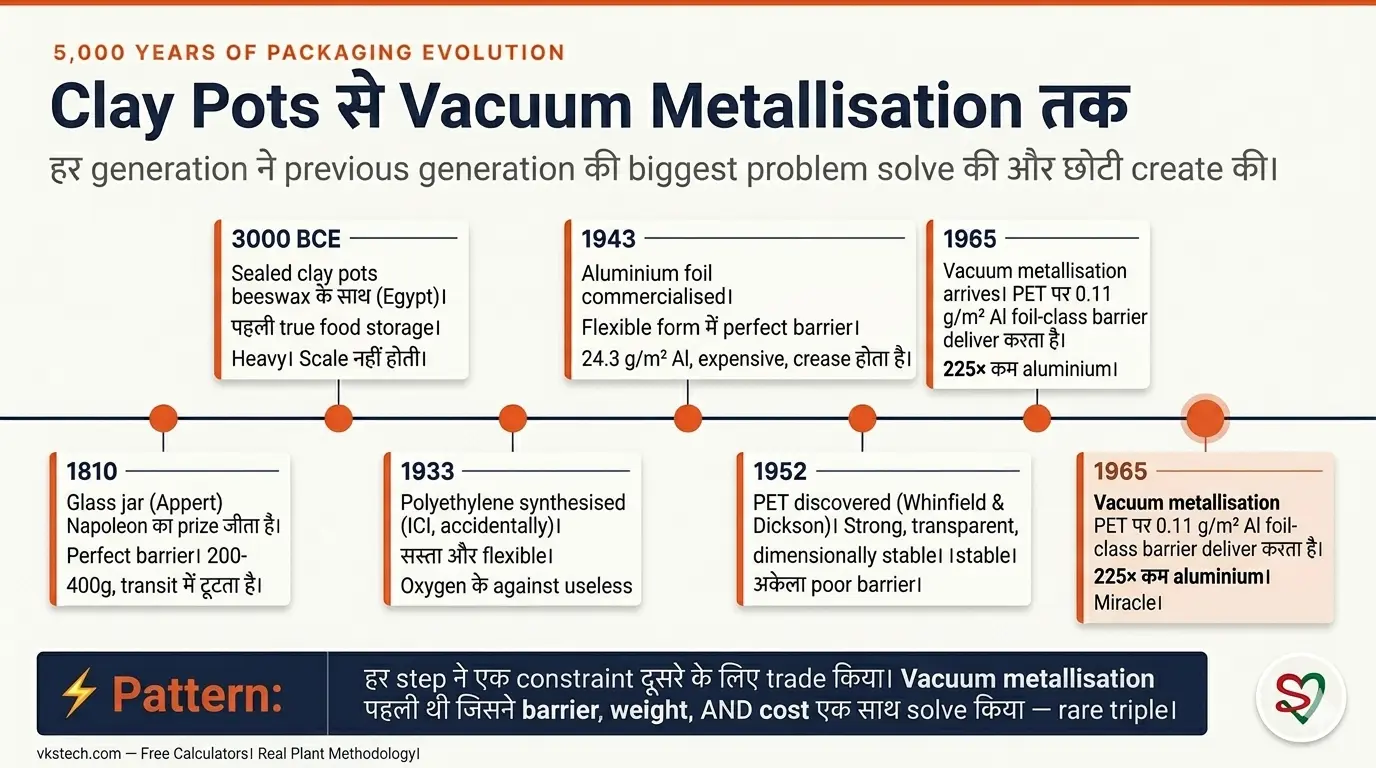
Vacuum metallisation commercial process के रूप में 1965 के आसपास viable हुआ, और वो वो answer था जो industry search कर रही थी। Principle straightforward है: solid aluminium को लगभग 1500°C तक vacuum chamber के अंदर heat करो जब तक वो vaporise हो जाए, फिर aluminium vapour को moving plastic film पर condense होने दो। Deposit aluminium layer microscopically thin है — typically 40 nanometres, जो 0.04 microns है, जो लगभग 200 atoms thick है। फिर भी वो infinitesimal layer underlying PET की oxygen transmission को 200 factor से reduce करती है, और moisture transmission को 80 factor से।
Economics transformative थे। True aluminium foil 9 microns पर 24.3 grams aluminium per square metre use करता है। Metallised PET 40 nanometres पर 0.11 grams per square metre। Barrier essentially identical है। Aluminium consumption 225 गुना कम है। Film flexible, transparent (silver-grey rather than fully opaque), heat-sealable, और printable रहती है। पहली बार, industry के पास material था जो foil-class barrier deliver कर सकता था plastic-class economics पर।
200-atom-thick vapour-deposited aluminium layer 12-micron PET film को 9-micron aluminium foil जैसी same barrier performance देती है — 225 गुना कम aluminium use करके, एक-दसवें weight पर, fraction of cost पर। India आज जिस तरह खाता है उसका लगभग सब कुछ इस single industrial achievement के downstream है।
📊 क्यों Matter करता है — Barrier Numbers
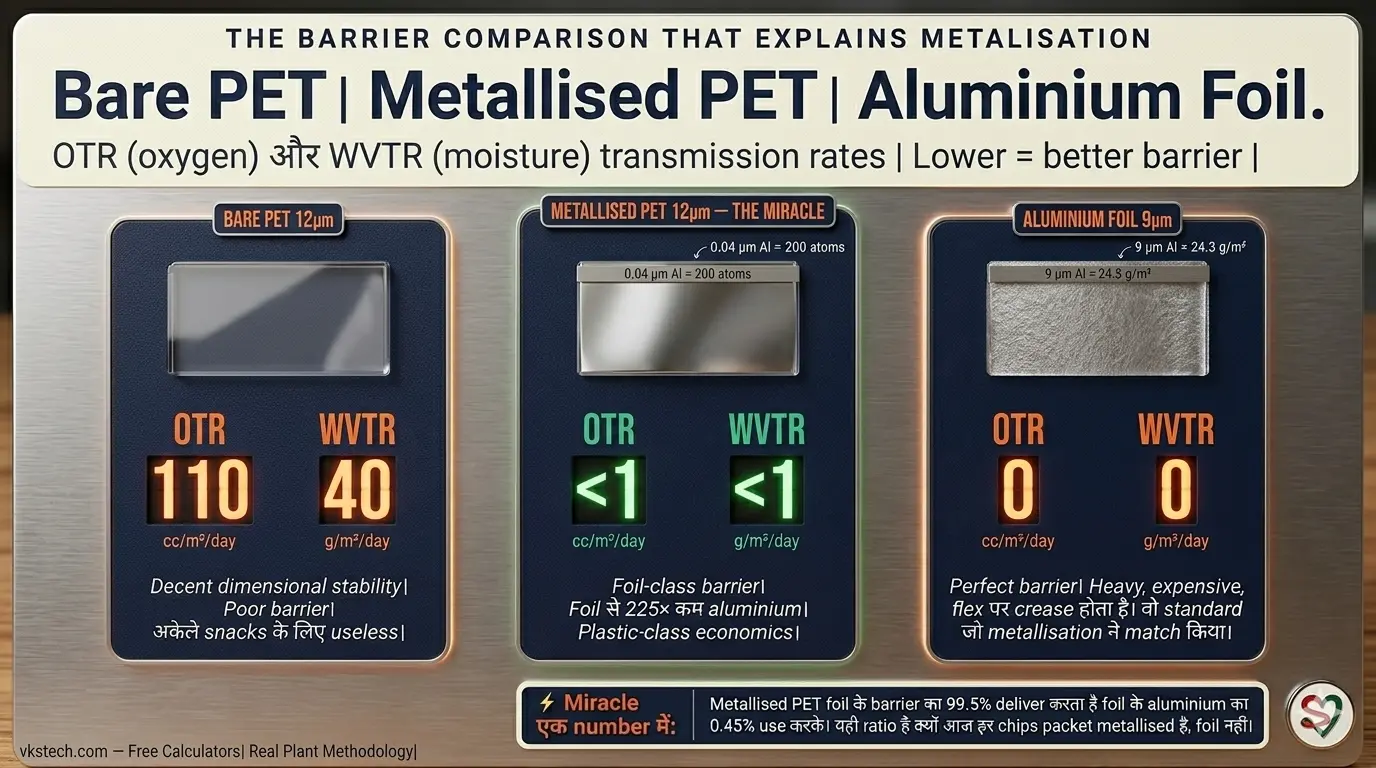
दो numbers जो decide करते हैं कि package काम करेगा या fail होगा वो हैं OTR (Oxygen Transmission Rate) और WVTR (Water Vapour Transmission Rate)। OTR cc/m²/day पर 23°C, 50% RH पर measure होता है। WVTR g/m²/day पर 38°C, 90% RH पर। Lower numbers मतलब better barrier। Series का अगला blog — Blog 34 — इन दो numbers का complete explainer है और कैसे spec करें। अभी के लिए, नीचे की comparison table वो हिस्सा है जो metallisation matter करने को समझने के लिए ज़रूरी है:
| Substrate | OTR (cc/m²/day) | WVTR (g/m²/day) | Verdict |
|---|---|---|---|
| Bare PET 12μm | ~110 | ~40 | Decent dimensional stability, poor barrier |
| Bare BOPP 20μm | ~2,400 | ~6 | Good moisture, terrible oxygen |
| Bare LDPE 50μm | ~7,800 | ~18 | Good moisture, no oxygen barrier |
| Paper (kraft) | essentially infinite | essentially infinite | Coating या lamination के बिना no barrier |
| Metallised PET 12μm | ~0.5 | ~0.5 | Foil-class — bare PET से 200× better |
| AlOx PET 12μm (transparent) | ~0.7 | ~0.5 | Mono-material recyclable, similar barrier |
| Aluminium foil 9μm | ~0 (absolute) | ~0 (absolute) | Perfect — heavy, expensive, creases |
| Glass jar | ~0 (absolute) | ~0 (absolute) | Perfect — heavy, breaks |
Table पूरी story बताती है। Plain plastic films, चाहे कितने भी सस्ते और flexible, leak करते हैं। Glass और foil perfect हैं पर weight, cost, और freight में heavy penalties pay करते हैं। Metallised PET उस rare zone में बैठता है जहाँ barrier flexibility से मिलता है affordability से — और वो combination है जिसने flexible packaging को 1980s में West में luxury format से आज India में dominant format बनने तक scale होने दिया।
🇮🇳 India Story — Metallisation इस देश की Geography से क्यों Match हुआ
Metallised film India में इतना heavily deploy होने का reason coincidence नहीं है। India की geography और economics ने एक packaging problem present की जो किसी और देश को same scale पर solve नहीं करनी पड़ी। Food supply chain एक factory से 2,000 kilometres दूर villages तक चलती है उन roads के across जो साल में दो बार wash out होती हैं, transit temperatures जो 45°C hit करते हैं, monsoon में humidity 90% exceed करती है, और consumer price points जहाँ packaging cost का हर paisa matter करता है क्योंकि food खुद ₹2 per gram पर बिकता है।
Glass और tin इस scale पर affordable नहीं थे। Bare plastic films monsoon में barrier test fail करते। Aluminium foil mass-market snacks के लिए expensive और freight-inefficient था। एकमात्र material जो वो barrier deliver करता था जो Noida factory से Bihar village तक 30-gram namkeen pouch को छह महीने fresh रखे — 30 paise per pouch cost पर — वो metallised PET था। Indian flexible packaging industry जो 1990s और 2000s में scale हुई, real sense में, इसी single material innovation पर built थी।
Downstream effects हर kirana counter पर visible हैं। आज tier-3 और tier-4 towns तक पहुँचने वाले branded snacks, biscuits, namkeen, और confectionery वहाँ पहुँचते हैं क्योंकि किसी ने, 1965 में, figure out किया कि vacuum chamber के अंदर plastic film पर 200 atoms aluminium कैसे deposit करें। ये literal causal chain है।
⚖️ Metallisation ने जो Trade-off Create किया
Metallisation ने barrier problem को इतना completely solve किया कि उसने एक नई problem create कर दी जिस पर industry अब भी काम कर रही है: recyclability। Metallised PET pouch technically multi-material laminate है (PET + aluminium + sealant) और EPR Category III bucket में आता है — सबसे hard recycle करने वाला, post-use disposal में सबसे expensive। Indian EPR Amendment Rules जो April 1, 2026 से effective हैं ने इस cost को negligible से लगभग ₹17.50 per kg MLP तक raise किया।
Industry का response mono-material structures की shift है — particularly AlOx-coated PET, जो metallised PET का ~95% barrier full mono-PET recyclability के साथ deliver करता है (EPR Category II, ~₹4 per kg)। मैंने इस trade-off को detail से Blog #31 में cover किया — metallised PET और AlOx के बीच choose करने का four-lens framework, और कब हर एक किस product line के लिए sense रखता है।
यहाँ समझने worth point ये है कि metallisation ने जो problem solve की वो उससे बड़ी है जो उसने create की। Metallisation ने हमें 60 साल food security at scale दी। Recyclability problem real है और solve हो रही है। Packaging materials का history हर generation का history है previous generation की biggest problem solve करने और छोटी create करने का। हम उस cycle में हैं अब। AlOx और mono-material future probably अगला chapter होगा, अपने trade-offs के साथ जिनके बारे में कोई 2050 में लिखेगा।
🔬 Metallisation को Actually क्या चाहिए — Process एक Page में
Real plant पर vacuum metallisation process चार stages पर आता है, हर एक अपनी engineering constraints के साथ:
| Stage | क्या होता है | क्यों Matter करता है |
|---|---|---|
| 1. Vacuum | Chamber 10⁻⁴ mbar तक pump (basically space) | Vacuum के बिना, aluminium mid-flight oxidise होता है और film तक कभी नहीं पहुँचता। 10⁻⁴ mbar के नीचे, Al atoms का mean free path chamber dimensions exceed करता है। |
| 2. Boat heating | Ceramic boats ~1,500°C तक heated | Aluminium 660°C पर melt होता है पर vapour pressure useful सिर्फ़ 1,400°C के around होता है। 1,600°C के ऊपर boats burn out हो जाते हैं। |
| 3. Vapour deposition | Al vapour rise करता है, 600-800 m/min पर moving film पर condense | Film boats के 30-50cm ऊपर pass करती है। Deposit thickness line speed (slower = thicker), boat current (higher = more vapour) से control। |
| 4. Cooling + winding | Film chill drum से cool, tension के नीचे rewound | Hot film deposits distort करते। Tension control rewind पर telescoping या starring prevent करता है। |
इस process को industrial scale पर run करने का economics — boat life, source cleaning frequency, vacuum pump-down time, capacity planning — exactly वो है जिसके बारे में बाक़ी site है। Blog #30 rolls-per-day calculation walk करता है। Blog #29 different substrates के लिए equivalent factor cover करता है। Blog #28 cost equation handle करता है। Why-we-do-this story यहाँ ख़त्म होती है। How-we-do-this story उन technical blogs में है।
🎯 Question का Answer
तो हम metallise क्यों करते हैं? क्योंकि human food preservation के 5,000 साल arc में, किसी और material ने foil-class barrier plastic-class economics पर deliver नहीं किया। Glass jars काम करते हैं पर टूटते हैं। Tin cans काम करते हैं पर heavy हैं। Aluminium foil काम करता है पर necessary से 225× ज़्यादा aluminium cost करता है। Plain plastic films सस्ते और flexible हैं पर leak करते हैं। Metallisation वो rare material technology है जो तीनों constraints एक साथ solve करती है — barrier, weight, और cost — और वो solution है जिसने एक billion Indians को branded packaged food access करने दिया continental supply chain के across affordable price पर।
ये perfect packaging नहीं है। Mono-material structures probably अगला chapter होगा। Recyclability problem real है और EPR transition के through address हो रही है। पर 1980 और आज के बीच delivered food security gains के लिए, metallisation वो credit deserve करता है जो उसे public conversation में rarely मिलता है। अगली बार जब आप 30-gram namkeen pouch खोलें, अंदर की silver-grey shine 200 atoms aluminium है जो vacuum chamber से आपकी kitchen तक travel की, 5,000 साल पुरानी human problem की service में। ये समझने worth है।
📚 इस site पर related reads: ये blog explain करता है कि metallisation क्यों exist करती है। कैसे operate करें वो operations series में है — Blog #30 rolls-per-day capacity calculation के लिए, Blog #28 conversion cost के लिए, Blog #31 AlOx vs Metallised PET / EPR-recyclability decision के लिए, और Blog #32 क्यों polyethylene packaging disposal problem के बावजूद food security के लिए net positive है।
किसी specific food category और उसे really क्या barrier चाहिए के बारे में curious हैं? Discuss करना चाहते हैं कि क्या AlOx पूरी तरह metallised PET को replace करेगा, या हर एक कहाँ dominate करेगा? अपना सवाल इस page के bottom पर Q&A section में डालें — मैं हर thoughtful pushback का personally जवाब देता हूँ।
📌 आगे क्या। Blog 34 इसका technical companion होगा — Barrier Properties: OTR & WVTR Explained — दो numbers में deep dive जो decide करते हैं हर package क्या hold कर सकता है और क्या नहीं, calculator के साथ जो किसी भी food category के लिए right barrier structure recommend करे।